Support quality and reviewer calibration
Customer Support QA Scorecard Template and Calibration Guide
Published · Last updated
A customer support QA scorecard turns a conversation into an evidence-based review. Actigy BPO’s template uses six weighted criteria, explicit scoring anchors and a separate critical-failure decision. It includes worked examples and a calibration log so reviewers can explain the score and agents can act on the feedback.
Start with the result the customer needed. Was the issue understood, was the answer correct, and did the next step happen? A friendly message can still leave a customer with the wrong answer. A useful scorecard makes that failure visible without reducing the whole review to tone or speed.
Open the free Actigy BPO support QA scorecard. Use the browser tool to calculate a score or download the editable template data. No registration is required. Keep customer transcripts and identifying information in approved systems; the tool only needs scores and a critical-failure status.
What the 2026 research changes about QA
Qualtrics’ 2026 Agent Effectiveness Benchmark Study surveyed 7,001 consumers in seven countries and seven industries during December 2025 and January 2026. In its June analysis, AI interactions scored 4.41 for friendliness and 4.08 for understanding, a 0.33-point gap. That is an observational finding, not proof that any particular scoring framework causes better outcomes. Qualtrics study and methodology
Zendesk’s CX Trends 2026 research provides a second reason to inspect the handoff. It reports that 74% of consumers become frustrated when they repeat information, while 95% expect an explanation for AI-made decisions. The study combined 6,182 consumer responses and 5,115 business responses across 22 countries in June 2025. These two percentages concern consumers. They are not contact-center error rates. Zendesk research release
Actigy BPO’s editorial response is to score understanding, factual accuracy and ownership explicitly. Keep warmth in the rubric, but do not let it conceal an unresolved issue. For broader operating measures, use the separate customer service statistics and call center KPI guide.
The free customer support QA scorecard
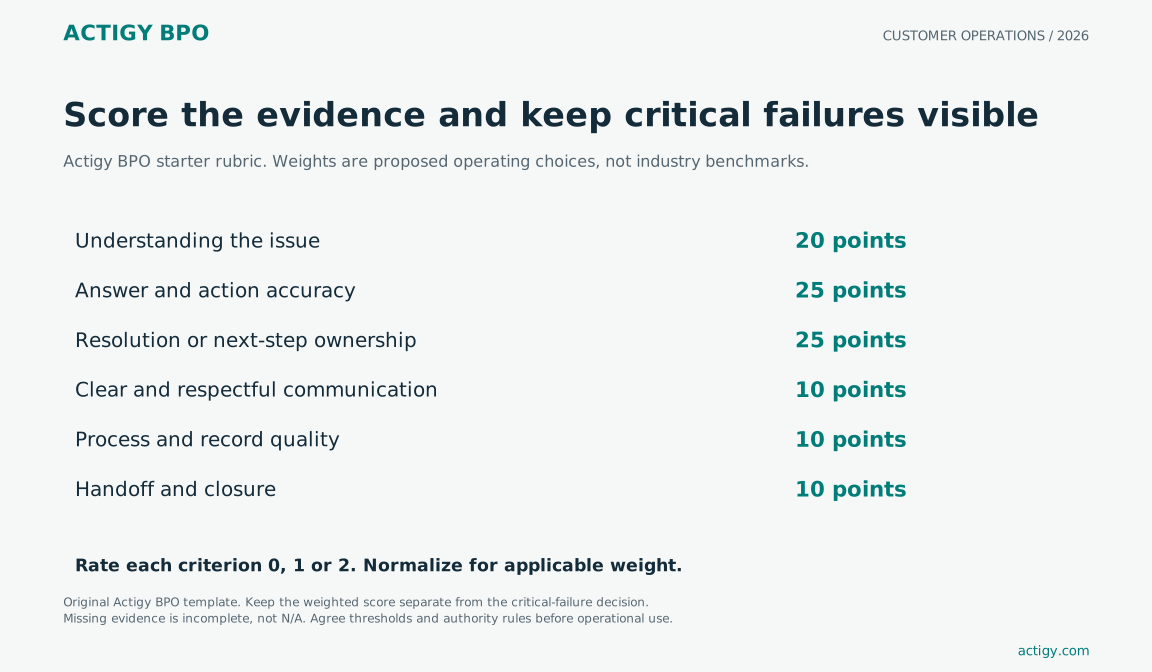
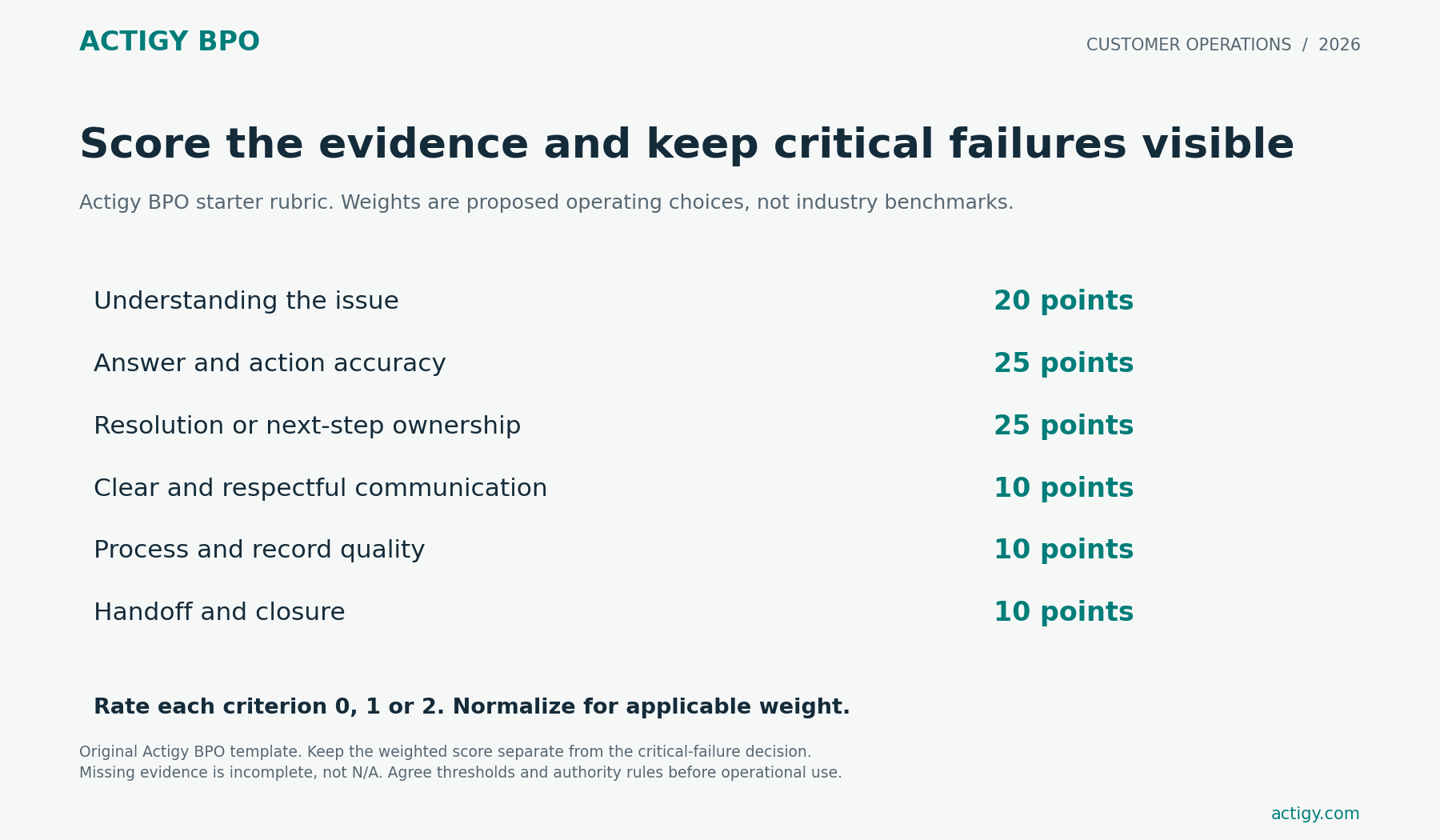
Use a 0, 1 or 2 rating for every applicable criterion. Zero means the required behavior failed or was absent. One means it was partly met with a documented deficiency. Two means it was fully met. Every deduction needs an evidence reference and a brief explanation. Use N/A only when the behavior truly did not apply.
| Criterion | Weight | What a full score requires |
|---|---|---|
| Understanding the issue | 20 | Correctly identifies the customer’s problem and relevant context; asks necessary questions without repeating answered ones |
| Answer and action accuracy | 25 | Uses current approved information; gives correct instructions and takes only authorized actions |
| Resolution or next-step ownership | 25 | Resolves within authority or provides an accurate next step with a named destination and realistic expectation |
| Clear and respectful communication | 10 | Explains the answer in understandable language and responds appropriately to the customer’s circumstances |
| Process and record quality | 10 | Follows the applicable workflow and leaves a usable record of the issue, action and outcome |
| Handoff and closure | 10 | Carries relevant context to the next owner or closes with an accurate summary and contact route |
The weights add to 100. They are Actigy BPO’s proposed starting template, not a validated industry standard. Review them against your products, channels and risk. Keep the same version within a reporting cohort so a weight change does not masquerade as a performance improvement.
Give each rating an observable anchor
The overall scale needs concrete examples. For accuracy, a score of 2 means the substantive answer and authorized action are correct. A score of 1 might reflect an incomplete but non-critical explanation that requires clarification. A score of 0 means a materially wrong answer or action. If the error also meets an approved critical-failure rule, record that separately.
For ownership, award 2 when the agent either resolves within their authority or completes the correct escalation with a clear next step. A necessary escalation can be good work. Award 1 when the next step is relevant but incomplete. Award 0 when the customer is abandoned or given an unsupported promise. Do not penalize an agent simply because a client-owned engineering or financial decision was required.
For understanding, a 2 requires the response to address the actual issue and available context. A 1 can reflect a partial diagnosis that misses an important detail. A 0 means the response solves the wrong problem. Write channel-specific examples into your policy before production scoring.
Use the support QA scorecard
Use the evidence anchors above. N/A removes a criterion from the denominator; missing evidence leaves the review incomplete. Keep customer transcripts and identifying details in approved systems. This browser tool uses only ratings and a critical-failure status, and sets no universal pass mark.
Weighted score unavailable. The review is incomplete.
Download the editable QA scorecard data (JSON) · Download the calibration log template (JSON)
Calculate the weighted score correctly
Weighted QA score = 100 × [sum of (weight × rating ÷ 2) for applicable criteria] ÷ sum of applicable weights.
With all six criteria applicable, the denominator is 100. If a criterion is genuinely not applicable, remove its weight from both the earned-point calculation and the denominator. Do not enter a zero for N/A. A missing review is also not N/A: leave the evaluation incomplete until the reviewer supplies the evidence.
| Worked example A | Weight | Rating | Earned points |
|---|---|---|---|
| Understanding | 20 | 2 | 20 |
| Accuracy | 25 | 2 | 25 |
| Ownership | 25 | 1 | 12.5 |
| Communication | 10 | 2 | 10 |
| Process and records | 10 | 1 | 5 |
| Handoff and closure | 10 | 2 | 10 |
| Total | 100 | 82.5 |
This fictional interaction scores 82.5%. The answer is correct, but the next step and internal record need improvement. Feedback should identify the missing owner or record detail, then show what a complete handoff would contain. The number summarizes the review; it is not the coaching instruction.
For example B, suppose handoff and closure is genuinely inapplicable under the approved rubric, with all other ratings unchanged. Earned points are 72.5 and applicable weight is 90. The normalized score is 80.6%. Reclassification has changed the denominator, so the score is not calculated as 72.5 out of 100. If all criteria are N/A, the result is unavailable.
Keep critical failures outside the average
A weighted average can hide a serious failure. Define a short list of critical events, such as unauthorized disclosure, a prohibited financial action or a material false statement about a consequential outcome. The precise list and escalation route must come from the client’s approved policy.
Record the numeric score and the critical-failure result separately. Under this template, a confirmed critical failure produces “Critical failure requires review” even when the weighted score is high. It does not silently rewrite the score to zero. This preserves the diagnostic detail and prevents an apparently strong average from becoming a pass.
The tool deliberately has no universal pass mark. The owner must set acceptance thresholds and critical rules for the specific service. A critical-failure allegation needs evidence and the authorized review process; a draft AI flag is not a final finding about an agent.
Calibrate reviewers before comparing agents
Calibration asks whether reviewers apply the same rubric to the same evidence. Select a small set of representative conversations, remove unnecessary identifying details and have reviewers score independently before discussion. Include an ambiguous case and a possible critical event as well as straightforward work.
The Actigy BPO calibration log records case reference, rubric version, criterion, reviewer A rating, reviewer B rating, evidence reference, adjudicated rating, rationale and required rubric change. Keep original ratings so agreement can be measured before the group reaches consensus.
For an illustrative set of 20 conversations with six applicable criteria, there are 120 paired ratings. If reviewers agree on 102, raw agreement is 85%. Calculate critical-failure agreement separately because a large number of easy matches can conceal disagreement about serious events. Raw agreement does not adjust for chance and should not be presented as a validated reliability statistic.
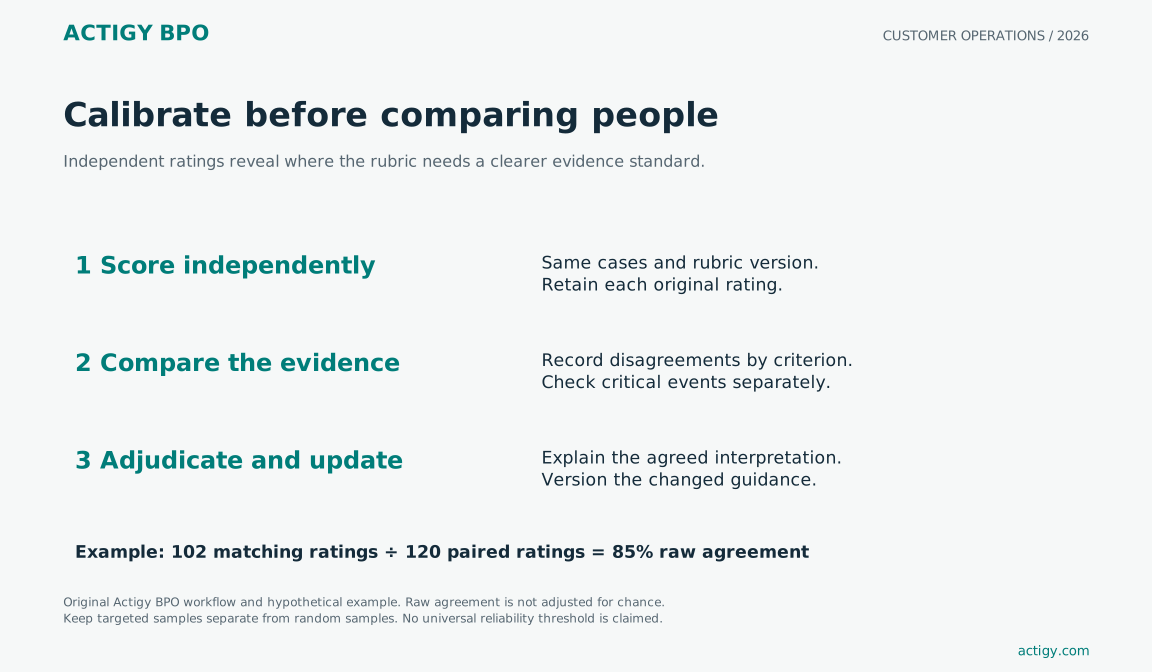
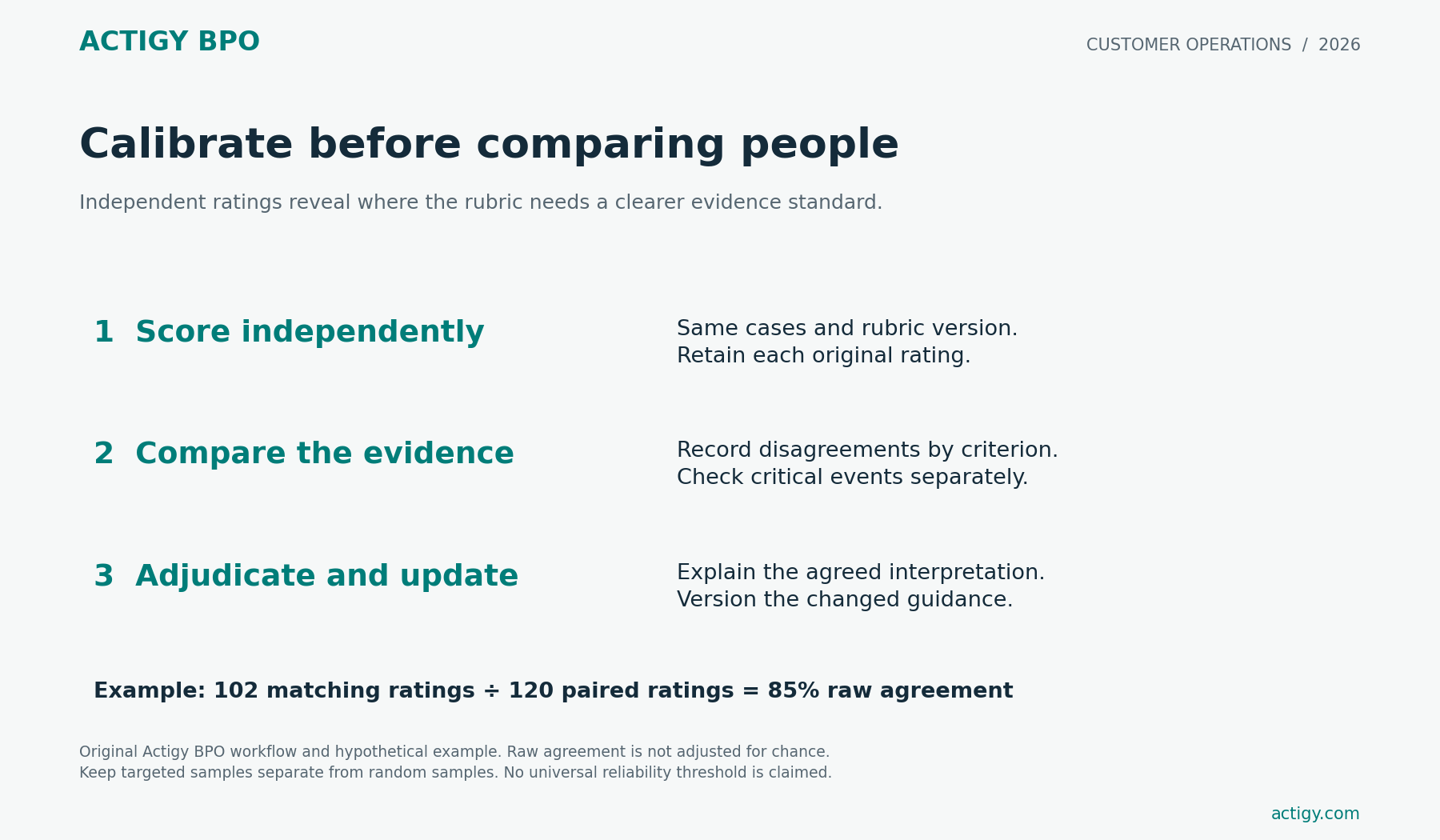
Resolve disagreement by finding the relevant evidence and refining the anchor. Avoid simply averaging opposing ratings. Publish the updated guidance, record when it takes effect and recheck the affected example. For an agent challenge, preserve the original review, the response and the authorized final determination.
Choose a sample that answers the question
A random sample helps inspect routine work. Targeted reviews help investigate complaints, escalations, new agents or possible critical failures. Keep the two groups identifiable. A complaint-heavy sample will not estimate the error rate of the entire support queue.
For a fictional 40-case review, suppose 30 randomly selected conversations contain three defects and 10 targeted escalations contain four. The combined sample has seven defective conversations, or 17.5%. Report the selection groups separately. Do not claim that 17.5% of all customer interactions are defective.
The right sample size depends on the question, volume, risk and desired precision. There is no universal “five calls per agent” rule in this guide. If a result will drive a consequential personnel decision or a population estimate, use a review design suitable for that purpose and an appropriate challenge process.
Apply the rubric across channels and AI support
For email, inspect whether the reply answers every material question and gives usable instructions. For chat, assess continuity across messages and handoffs. For voice, review what the recording supports, including explanations and commitments. A transcript alone may omit audible context, so disclose the evidence available to the reviewer.
For AI-handled interactions, preserve the approved knowledge version, relevant tool output and escalation record where available. Test factual correctness, authority limits and the transfer of context. Containment is the absence of a handoff; it does not establish resolution. Review cases where the AI appears successful as well as the cases it escalated.
If AI assists evaluation, compare its ratings with an independently reviewed reference set. Examine false critical flags, missed critical events and performance by channel. Record uncertainty and route disputed cases to a qualified reviewer. Do not allow an automated score alone to determine disciplinary action.
Connect QA with operating outcomes
Review QA alongside repeat contacts, reopened cases, complaints and customer satisfaction. These measures answer different questions. A low CSAT response may concern a product policy the agent could not change. A high CSAT response does not establish that every action complied with policy.
Compare similar work and report sample coverage. Look for recurring defects within a criterion, then test whether coaching or a process change reduces them. If ownership repeatedly fails because the escalation route has no available owner, repair the route as well as coaching the agent.
Where Actigy BPO fits
Actigy BPO customer support outsourcing provides managed support within agreed client systems, procedures and escalation boundaries. The scorecard can become part of a scoped delivery review, with the client approving policies, authority limits and acceptance criteria.
A useful pilot starts with one queue or channel. Agree the rubric, evidence access, calibration process, critical rules and client-owned decisions before production work. Use aggregate reporting to compare quality, backlog and cost with the baseline. Confirm any AI use in the written scope.
Build a support pilot around measurable quality. Discuss a support queue with Actigy BPO. Share the channels, approximate volume, systems and recurring failure patterns. Bring the scorecard to the process audit so the paid pilot tests a clear standard.
Frequently asked questions
What is a good customer support QA score?
A good score meets the locally approved standard for that rubric and workload, with no unresolved critical failure. Percentages from different weights, scales or samples are not directly comparable. This template supplies definitions and calculations rather than an invented universal pass mark.
Is QA the same as CSAT?
No. QA examines the interaction against an agreed rubric. CSAT records a customer’s reported satisfaction. Use both and investigate disagreements. Neither should silently substitute for the other.
How should N/A criteria be scored?
Exclude genuinely inapplicable criteria from earned points and available weight. Preserve the reason. Missing evidence or an unfinished review remains incomplete; it is not automatically N/A or a pass.
Can the same scorecard evaluate human and AI support?
The core outcome criteria can be shared, but the evidence and authority limits differ. Add channel-specific anchors, preserve AI tool and knowledge context where available, and validate automated evaluation separately. Apply critical rules through an authorized review process.
What should a calibration session produce?
A documented explanation of disagreements, an adjudicated example and any needed rubric change. Retain independent scores to measure agreement before discussion. The objective is a repeatable standard that reviewers and agents can understand.
Methodology and reuse
Actigy BPO created this scorecard, the worked examples and calibration log as editorial operating resources. They are not findings from an Actigy BPO client survey or a validated psychometric instrument. The Qualtrics and Zendesk figures retain their own populations and fieldwork dates. Neither publisher endorses this template.
Reuse the original template and graphics with visible Actigy BPO attribution and a link to this guide. Credit the underlying research publishers separately when quoting their findings. Keep sample-selection and critical-failure notes attached to any adapted scorecard.
Suggested citation: Actigy BPO. Customer Support QA Scorecard Template and Calibration Guide. Research checked 18 October 2026. https://actigy.com/resources/customer-support-qa-scorecard-template/