Healthcare research & planning tools
Prior Authorization Readiness Checklist for 2027
A payer’s API launch will not fix a request that lacks clinical evidence or disappears into an unowned queue. Practices preparing for 2027 need to test the whole route: the request, its receipt, the payer’s response and the staff action that follows.
The Actigy BPO Prior Authorization Readiness Checklist turns that work into 12 evidence checks. Use the downloadable template to assign an owner and a next action for each gap. The checklist is an operational planning tool for US practices, not a legal determination of compliance.
Published · Last updated
What changes in 2027?
CMS-0057-F requires affected payers to implement or enhance APIs, with compliance dates generally beginning in 2027. The precise dates depend on payer type. Operational requirements began earlier, generally in 2026. A provider should verify the payer product and relevant requirement before assigning a deadline. CMS
Actigy BPO defines operational readiness as a tested route from a complete request to a documented response and an assigned next action. A vendor roadmap or a successful connection alone does not demonstrate that the practice can resolve real exceptions.
Separate the deadlines and the scope
| Requirement | Timing or status | What the practice should verify |
|---|---|---|
| Operational changes under CMS-0057-F | Generally 2026 | Applicable payer category and service. Do not wait for an API to track response deadlines. |
| API requirements under CMS-0057-F | Generally beginning in 2027 | Exact payer or plan-year date, vendor release and available connection. |
| Drug provisions in CMS-0062-P | Proposal as checked 18 October 2026 | Monitor final rulemaking. Do not present a proposed October 2027 drug requirement as effective law. |
| Hospital electronic PA measure | Optional bonus in CY2027; mandatory CY2028 | Current hospital and critical access hospital program guidance. Other provider programs have their own measures. |
Sources for the timing table: CMS-0057-F fact sheet, CMS drug proposal and current CMS provider guidance. The 2024 fact sheet predates later changes to the hospital measure. Use current program guidance for reporting obligations.
For affected non-drug requests, CMS’s current FAQ sets maximum response times of 72 hours for urgent requests and seven calendar days for standard requests, subject to clinical urgency and permitted extensions. It excludes QHP issuers on the federally facilitated exchanges from these changed timeframes. Calendar time applies across submission channels. CMS
A response deadline is different from an approval guarantee or a claim-payment deadline. Confirm the applicable policy for each payer product, including state requirements and contractual terms. Avoid copying one deadline across every insurer in the practice management system.

What the newest public data reveal
KFF’s August 2026 analysis examined 2025 payer disclosures. In its appendix covering ACA federal Marketplace insurers with at least 1% market share, reported standard-request denial rates ranged from 3% to 27%; median response times ranged from zero to four days. These are insurer-level disclosures with inconsistent reporting, not a practice benchmark. KFF
Use a payer’s published figures as context for questions. A median below a deadline does not show that every request met it. Track the age of your still-open requests and investigate the slow cases rather than judging the queue by its median alone.
Track your readiness evidence
Use aggregate operational data only. No patient information is needed. Inputs stay in this browser and are not saved automatically.
Operational checklist, not a compliance certification. A check counts as verified only with an owner and evidence reference. Changes are not saved automatically; export before leaving.
The Actigy BPO readiness checklist
For each check, record Not started, In progress or Verified, then attach an evidence reference and an owner. Verified means someone inspected the relevant evidence. The browser checklist reports progress through these 12 checks; it does not produce a compliance rating.
| Check | Suggested owner | Evidence to retain |
|---|---|---|
| Payer scope | Billing lead | Record payer, product, service type, applicable rule and verified compliance date. |
| Technology route | EHR owner | Confirm the vendor release, enabled features, payer connection and test environment. |
| Submission evidence | Authorization lead | Demonstrate a request reference, receipt timestamp and retrievable payload record. |
| Clinical documentation | Clinical owner | Approve the evidence required for the selected service and who may sign it. |
| Response handling | Authorization lead | Test approval, denial and request-for-information responses. |
| Urgent routing | Clinical owner | Document how urgency is determined and who handles an approaching deadline. |
| Exceptions and fallback | Operations lead | Test connection failure, duplicate risk and the permitted alternative channel. |
| Authorization limits | Billing lead | Capture service, provider, dates, units and expiry conditions for the claim handoff. |
| Patient communication | Practice manager | Assign the owner of status updates and unresolved scheduling questions. |
| Access and audit | Security owner | Approve access, evidence retention and revocation procedures. |
| Performance baseline | Reporting lead | Record queue age, response time, staff effort and open requests by payer. |
| Launch decision | Accountable sponsor | Review test evidence, unresolved failures and a documented rollback plan. |
Build the payer map before the technical test
List the products behind the payer names on the schedule. Record service category, current submission route and the source used to confirm requirements. Separate medical items and services from drugs. Where scope or timing is unclear, assign a named person to resolve it before the team relies on the new route.
CMS recommends discussing capabilities, implementation timing, upgrades and testing with the EHR vendor. Ask for a demonstration using the practice’s actual workflow, with synthetic or appropriately de-identified test cases. Record what is available now and what remains on the roadmap.
Test the difficult responses
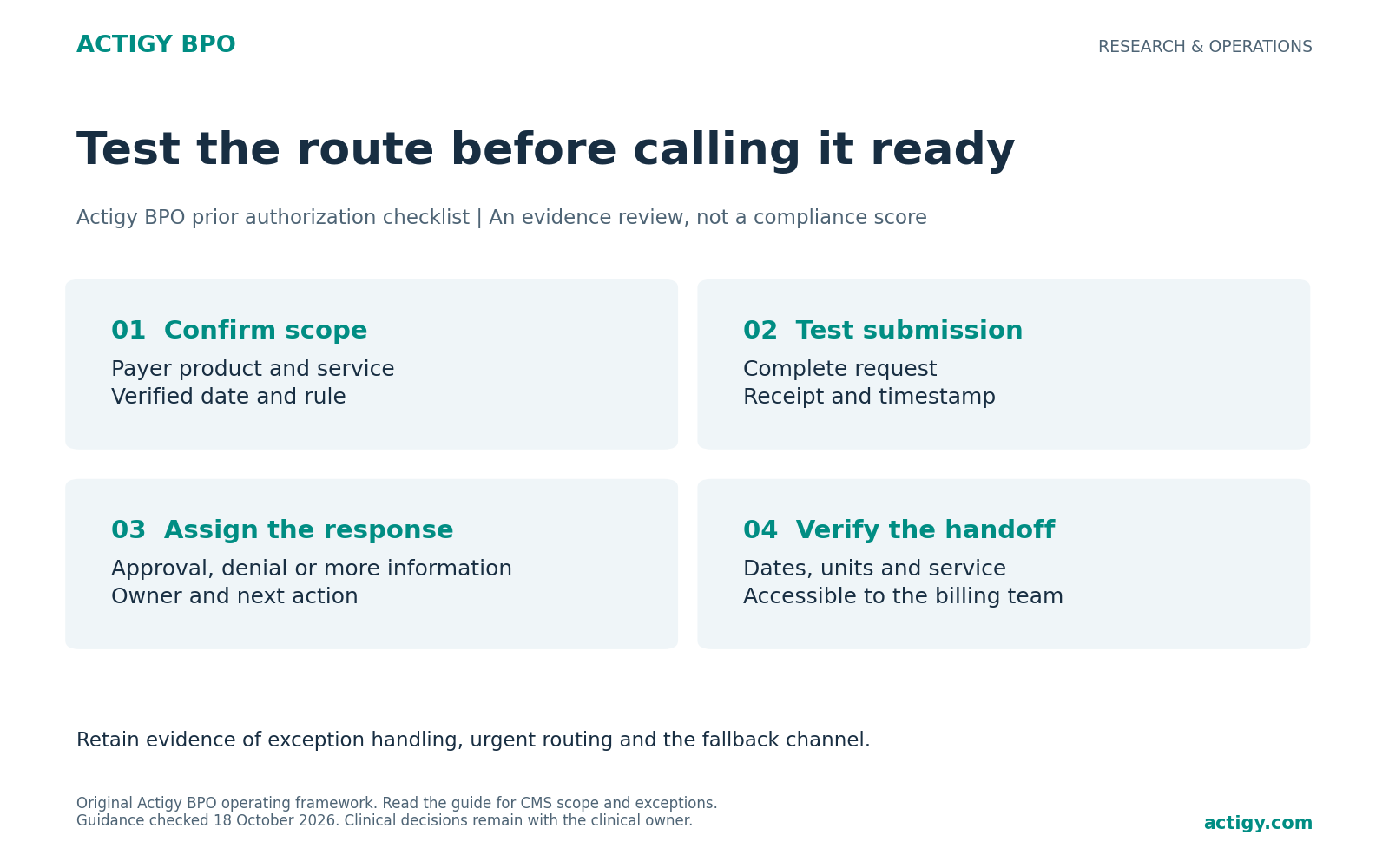
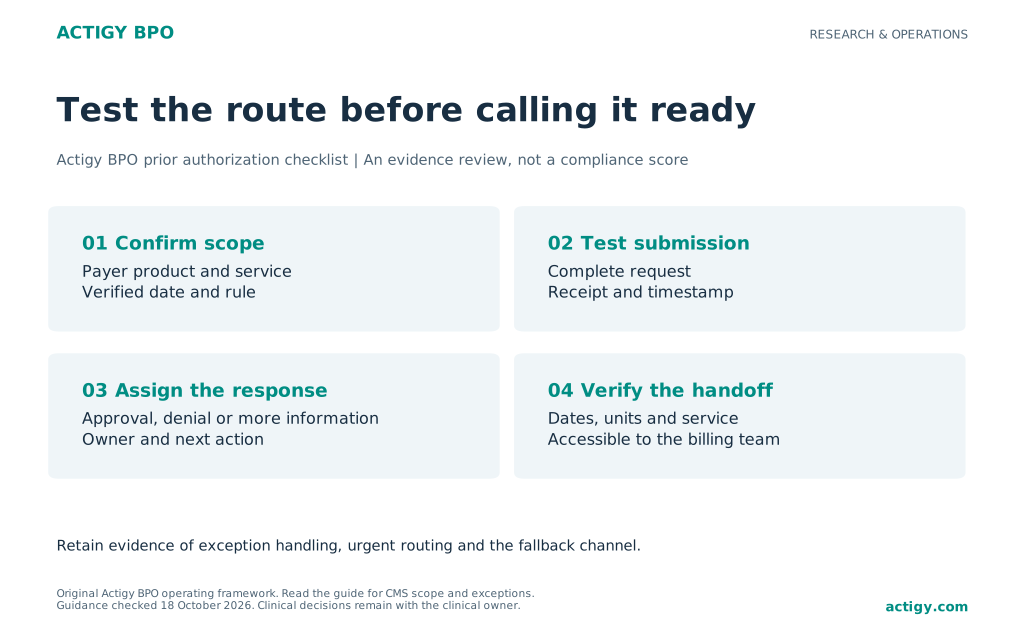
CMS describes three response types for the Prior Authorization API: approval with its end condition, denial with a specific reason, or a request for more information. CMS Build a test for each. The practice needs to know who receives it, what evidence appears in the work queue and who is responsible for the next action.
Also test an unavailable connection, a changed service date and a duplicate submission risk. Preserve the reference and timestamp when moving to a fallback channel. Assign the clinical owner to review clinical content and urgency; administrative support should not make those determinations.
Carry the approval into billing
Record the authorized service, provider, location where relevant, dates, units and expiry conditions. Make those fields visible to the team preparing the claim. Recheck them when scheduling or treatment changes. An authorization recorded somewhere in the chart is difficult to use if the billing team cannot find the scope.
Connect this handoff to eligibility verification and medical billing operations. The useful control is a complete, retrievable record at the point of work.
A practical four-week test
In week one, choose a limited payer and service segment, complete the scope map and document the current queue. In week two, work with the vendor on request and response tests. In week three, rehearse exception ownership and the fallback route. In week four, run a limited live workflow only after the authorized owners approve it.
Compare staff effort, requests awaiting information and unresolved queue age with the baseline. Record volume and case mix. If the test cannot preserve a receipt or route an urgent exception reliably, resolve that failure before widening the scope. Four weeks is a proposed working schedule; readiness depends on evidence, access and vendor availability.
Frequently asked questions
Does every practice need to build an API?
The payer API requirements do not mean every practice must build its own interface. Ask the EHR or integration vendor which supported connection the practice can use, and check any separate provider reporting requirements that apply.
Will electronic prior authorization approve every request instantly?
No. A request may be approved, denied or returned for more information. A useful implementation preserves the response and gives the next action to the right person.
Are drug authorizations covered by the same 2027 rule?
Do not assume they are. The non-drug scope of CMS-0057-F and the separate 2026 drug proposal must be read separately. Check the CMS proposal and any subsequent final rule before setting drug-related requirements.
What should the team measure after launch?
Measure request volume, staff minutes, incomplete submissions, response timing and unresolved cases by payer. Use the Actigy BPO RCM KPI dictionary to document each definition. A completed submission is a process event, not evidence of approval or eventual payment.
Scope the operating support
Actigy BPO’s prior authorization outsourcing service can be scoped around administrative preparation, status tracking and exception follow-up in approved systems. Clinical decisions remain with the designated clinical team. Request a process audit and paid pilot scope with your payer mix, service categories, systems and current backlog.
Download and cite the checklist
Use the ungated checklist to record status, evidence, owner and next action. Suggested attribution: Actigy BPO Prior Authorization Readiness Checklist for 2027, guidance checked 18 October 2026. Cite CMS for regulatory requirements and KFF for its research findings.
Sources and methodology
Primary research and official guidance were checked on 18 October 2026. Research dates and measurement periods are retained. Examples and tools are Actigy BPO planning resources, not measured client results.
CMS. CMS Interoperability and Prior Authorization Final Rule CMS-0057-F. 17 January 2024. Operational requirements generally start in 2026; API requirements generally in 2027. Scope and payer exceptions apply.
CMS. Improving Prior Authorization Processes. Accessed 18 October 2026. Calendar-time response requirements, QHP exception, conditional extensions and reporting scope.
CMS. Prior Authorization API. Updated 21 September 2026. API response requirements and guidance. Transport does not guarantee an approval.
CMS. Electronic Prior Authorization. Updated 14 September 2026. Current provider readiness guidance and links to changing program measures. Hospital measure optional bonus in CY2027, mandatory CY2028.
CMS. 2026 prior authorization for drugs proposed rule. 2026. A proposal. Proposed extensions are not treated as existing requirements.
KFF. Prior Authorization Metrics Provide New Insights into Insurer Practices but Gaps Remain. 13 August 2026. 2025 insurer website data. The appendix table for ACA federal Marketplace insurers with at least 1% market share supplies the cited ranges.
Free downloads
JSON templates and model data. No registration or patient information required.