Healthcare research & planning tools
Insurance eligibility verification checklist for medical practices
Insurance eligibility verification checks a patient’s coverage for a planned service date and records the benefits, requirements and questions that affect the visit. Actigy BPO’s Eligibility Evidence Checklist turns that work into 16 documented checks and a named handoff for anything unresolved. An active policy alone does not establish that a particular service will be paid.
The most useful output is a record the next person can act on. Scheduling needs to know what remains open. Billing needs the correct payer and supporting response. The patient needs a clear explanation of any estimate. A green eligibility indicator can hide gaps in all three.
Download the free Actigy BPO Eligibility Verification Toolkit. It includes the checklist, a payer-call guide and an exception handoff. The download is ungated. Use the workload calculator below for aggregate planning figures.
Published · Last updated
What the latest patient access research shows
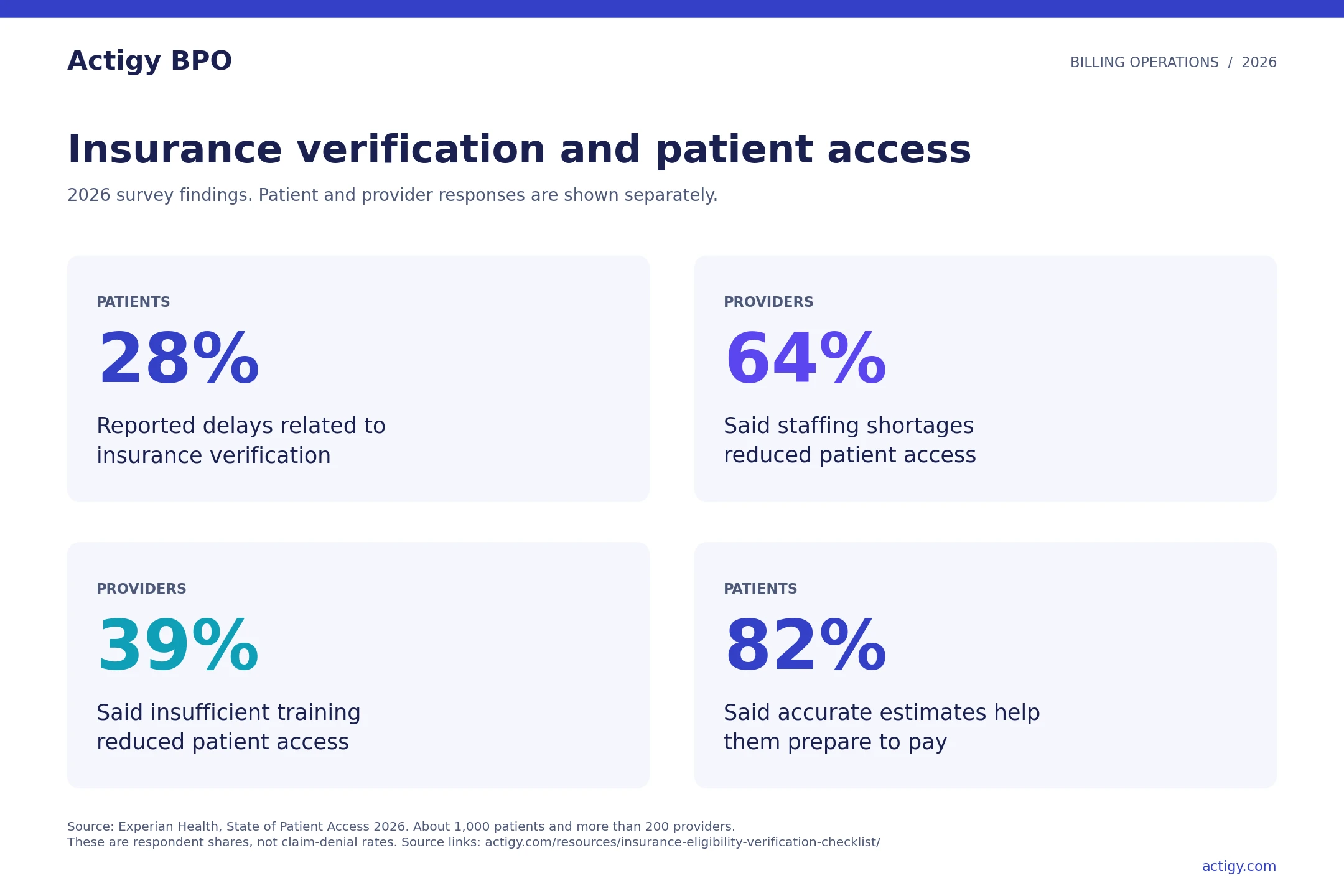
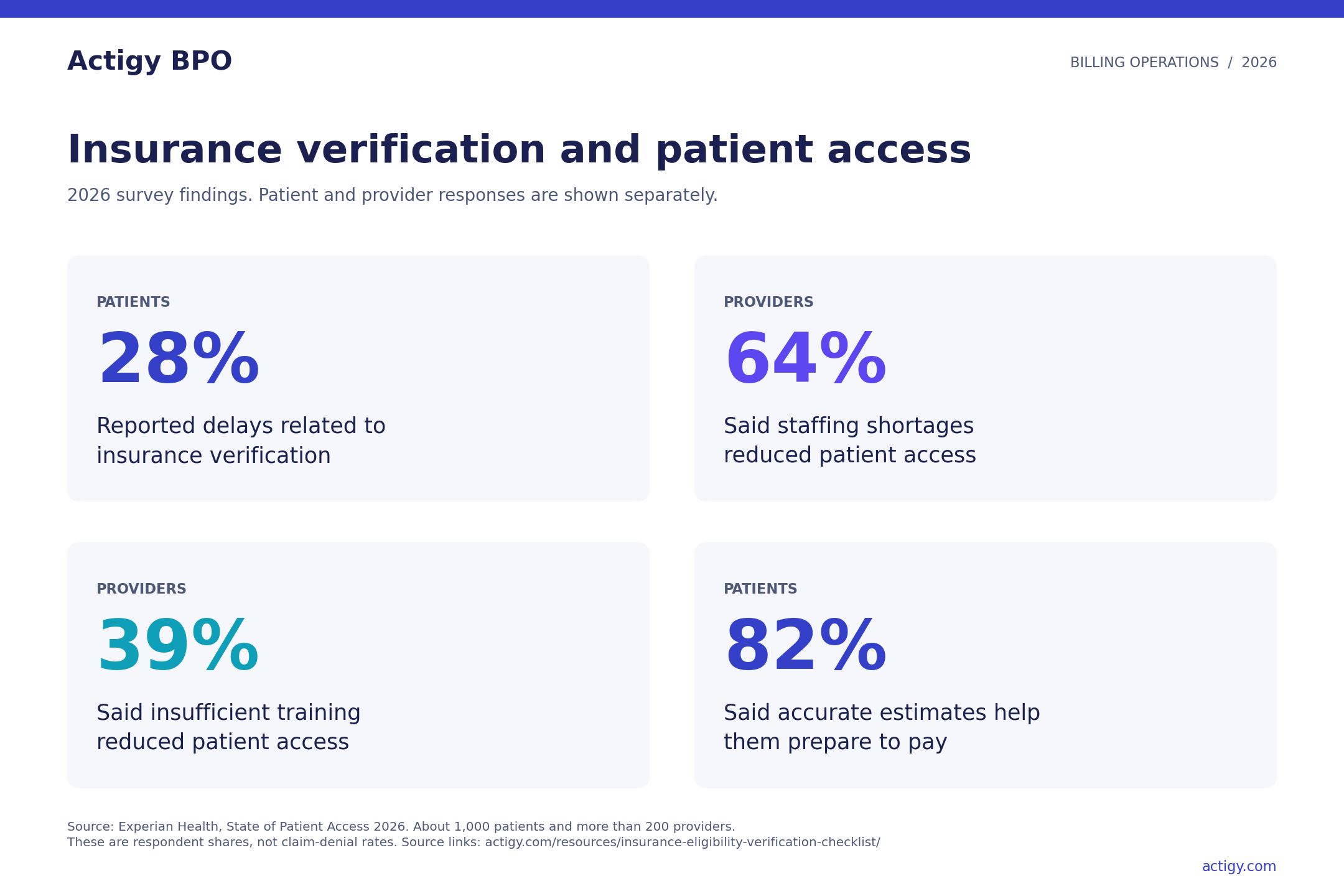
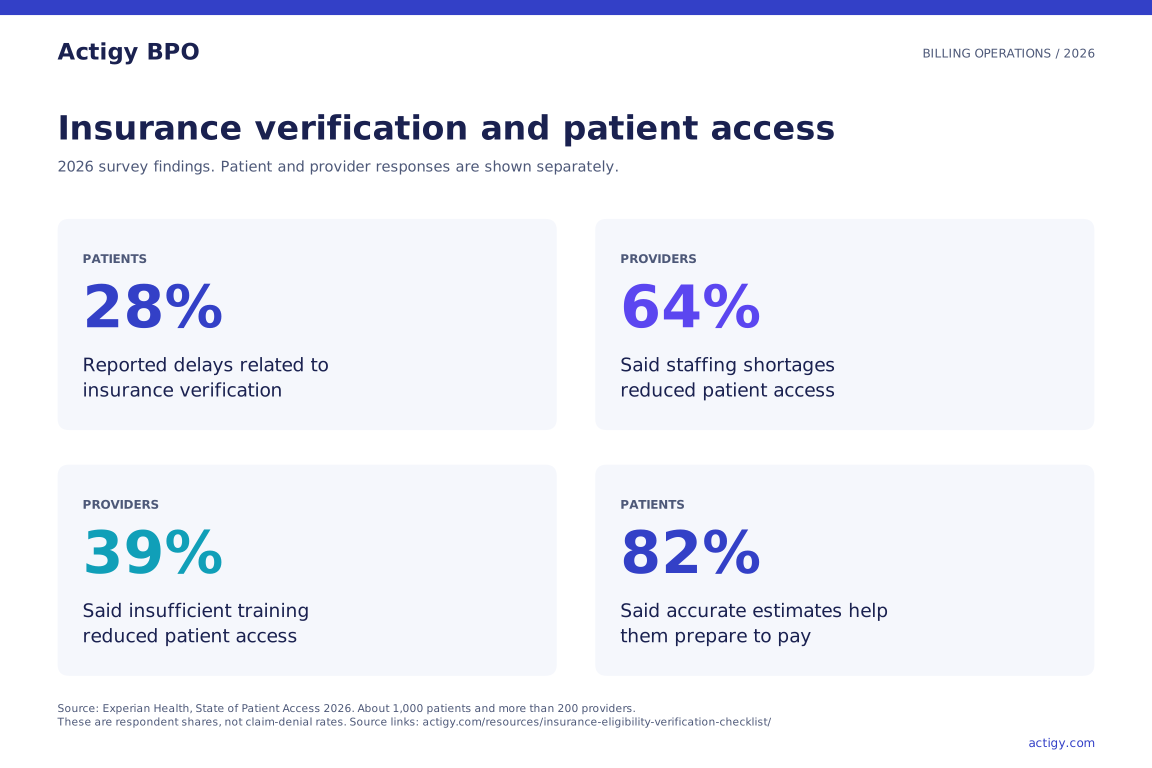
Experian Health’s 2026 survey connects verification work with the patient experience. Its release reports that 28% of patients experienced care delays related to insurance verification, while 64% of providers said staffing shortages reduced access and 39% identified insufficient training as an access problem. Those are survey responses from different populations, not denial rates. Read the March 2026 survey release.
| Finding | Population and period | What to examine locally |
|---|---|---|
| 28% reported verification-related delays | Patients in Experian’s 2026 survey | Unresolved checks close to the appointment |
| 64% said staffing shortages reduced access | Provider respondents in the same survey | Queue size, capacity and cover for absences |
| 39% said insufficient training hurt access | Provider respondents in the same survey | Errors repeated across staff and payer groups |
| 82% said an accurate estimate helps them prepare to pay | Patients in State of Patient Access 2026 | Whether verified information reaches the estimate |
The report covers about 1,000 patients and more than 200 providers. The 82% finding describes the value patients place on accurate estimates. It does not measure collection performance or prove that verification alone improves payment. See the report and its population notes.
Experian also reports that 45% of patients received a care-cost estimate, compared with 41% in 2025. That four-percentage-point change concerns receipt of an estimate, not its accuracy. It reinforces a practical question for the practice: does verified benefit information actually reach the person preparing and explaining the estimate? Read the publisher’s 2026 analysis.
Eligibility, benefits and authorization answer different questions
| Check | Question it answers | What still needs attention |
|---|---|---|
| Eligibility | Is coverage reported for this person and service date? | The particular service, provider and plan conditions |
| Benefits | What does the response say about the relevant service and cost sharing? | Missing details, exclusions, limits and changing accumulators |
| Authorization or referral | Is a required approval or referral documented for the intended work? | Its scope, dates, units and remaining payment conditions |
| Patient estimate | What is the patient expected to owe under the available information? | Actual services and final payer processing can change the amount |
Treat these as linked records with separate statuses. A completed eligibility inquiry should not close an authorization task. A submitted authorization request should not appear as an approval. If an estimate relies on incomplete benefits, record the uncertainty and send it to the authorized reviewer.
CMS identifies eligibility inquiries and responses with the 270/271 transaction and claim-status inquiries and responses with 276/277. Those are different exchanges. Use the payer response and the applicable operating rules to interpret the information returned. CMS explains the transaction scope.
The Actigy BPO Eligibility Evidence Checklist
Use the following checklist for a scheduled encounter. Mark each item Complete, Open or Not applicable. Complete means the required evidence is retained and reviewed under the practice’s procedure. A response that omits a material answer stays Open.
| Check | Record or action |
|---|---|
| 1 Patient and subscriber | Match the patient, subscriber relationship and member identifier to the approved record. |
| 2 Date of service | Request coverage for the planned service date and retain the inquiry date separately. |
| 3 Plan and coverage dates | Record the actual plan, effective date and any reported end date. |
| 4 Provider and location | Check the relevant provider, facility and location against the plan response. |
| 5 Payer order | Record other coverage and assign unresolved coordination-of-benefits questions. |
| 6 Planned service | Use the intended service details supplied by the responsible clinical or coding team. |
| 7 Relevant benefits | Record whether the response addresses the planned service and any unresolved exclusions. |
| 8 Cost sharing | Capture reported copay, deductible, coinsurance and accumulator information with the response date. |
| 9 Limits | Record reported visit, unit or frequency limits and any uncertainty about remaining benefits. |
| 10 Referral | Record whether a referral is required and whether the relevant referral is on file. |
| 11 Authorization | Track the requirement and current status, including applicable service, dates and units. |
| 12 Source | Keep the payer or approved intermediary, response reference and method used. |
| 13 Evidence | Retain the response in the approved system and identify the staff member completing the check. |
| 14 Unresolved questions | Assign an owner, next action and deadline to every material gap. |
| 15 Patient communication | Pass validated information to the authorized team and clearly label any estimate. |
| 16 Recheck | Set the next review trigger when the appointment, plan, service or response changes. |
This is an original operational checklist for local adaptation. It is not a payer form or a universal list of coverage requirements. The clinical and coding teams supply the intended service details. The practice sets care decisions, financial policies and any patient communication that requires judgment.
Route the result before closing the task
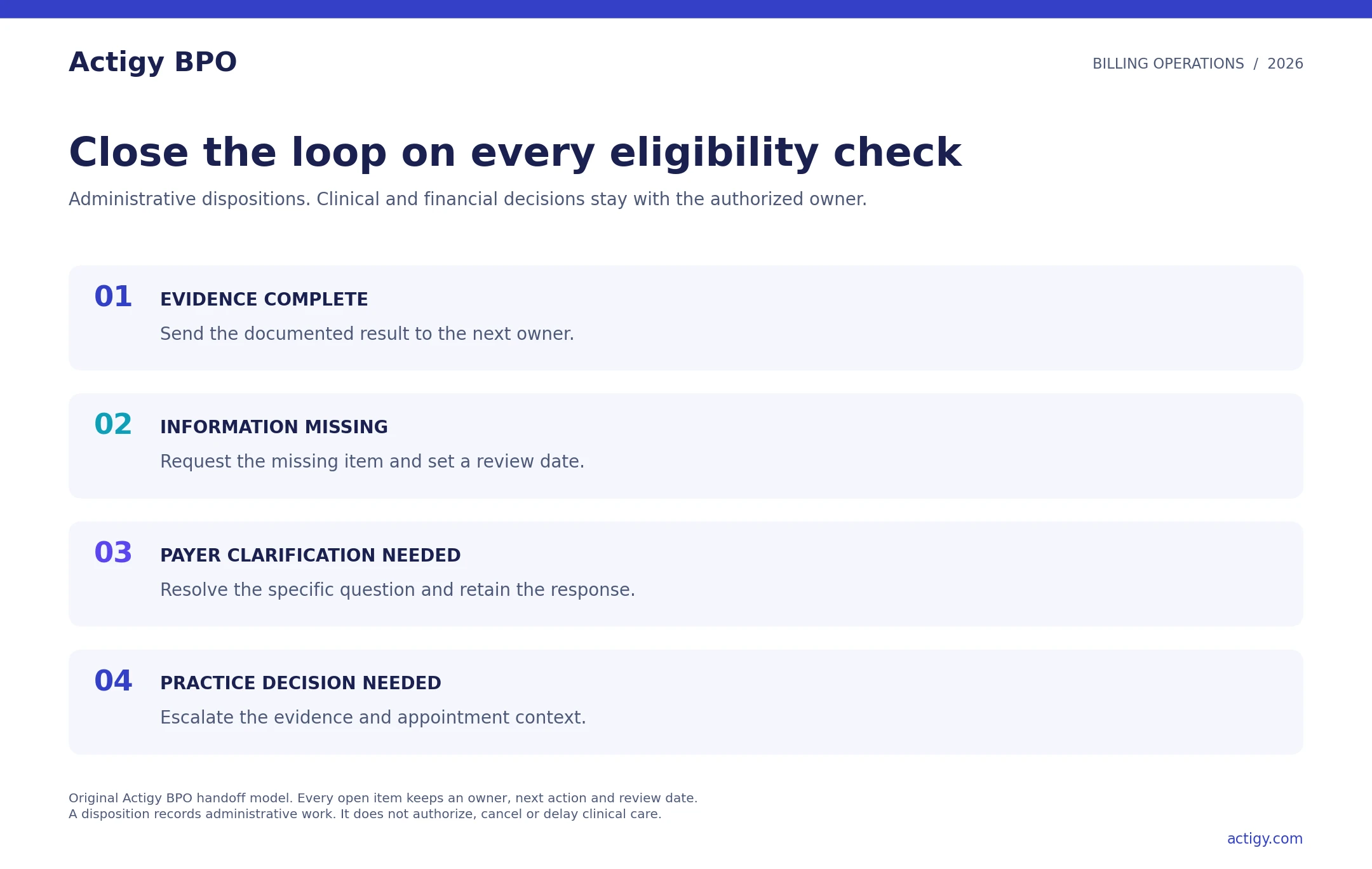
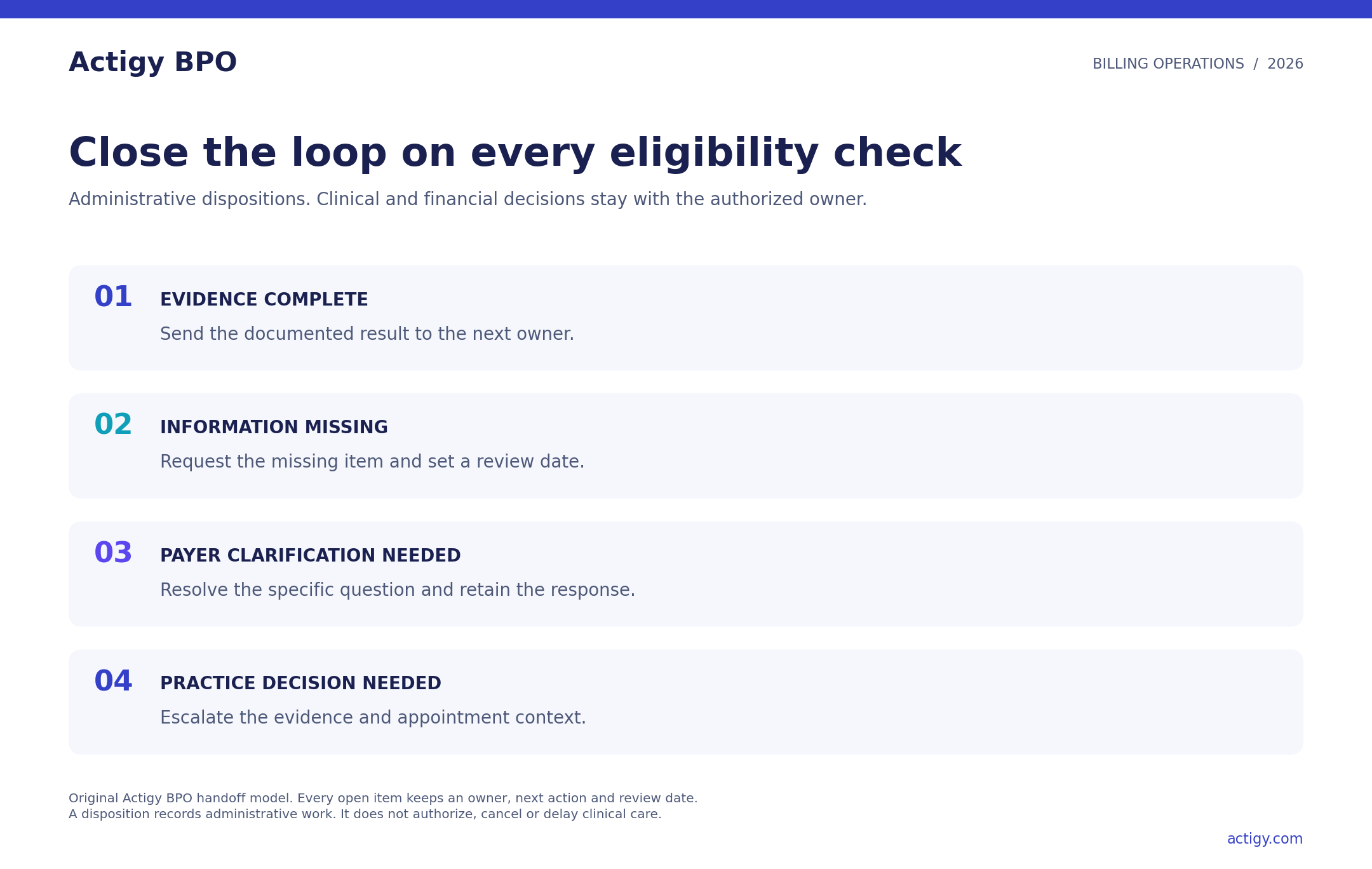
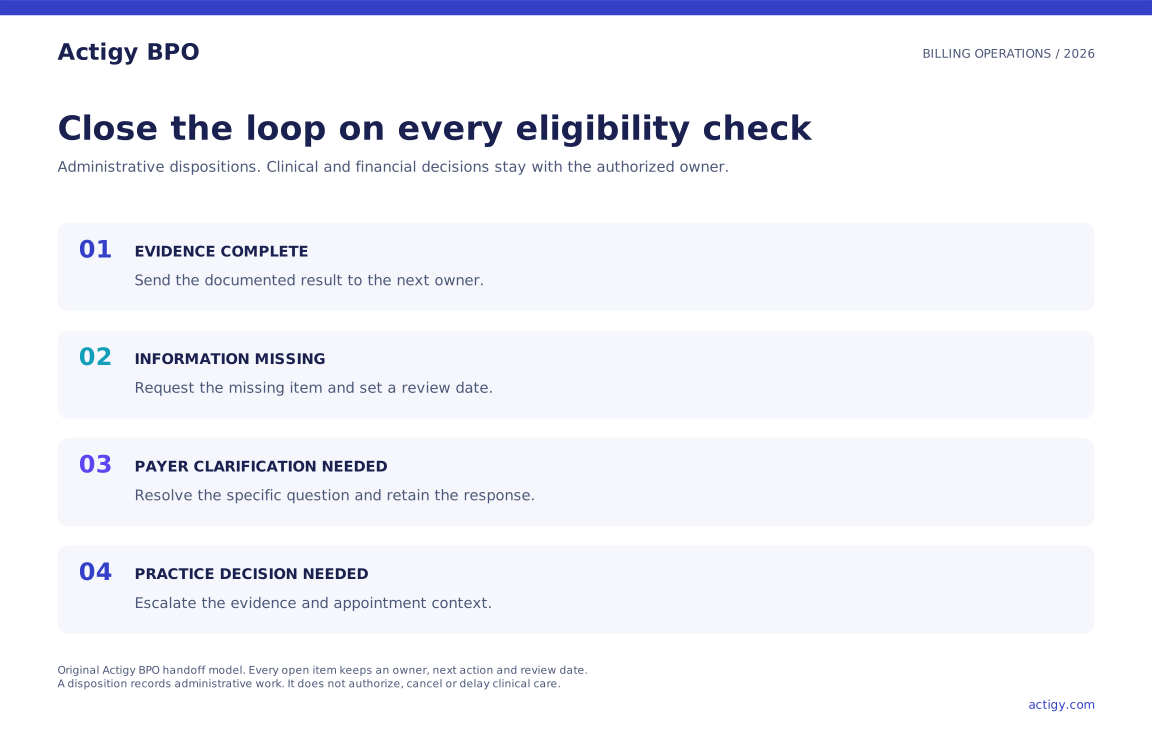
Use a small set of administrative dispositions so the record means the same thing across the team. The Actigy BPO handoff model below distinguishes completed evidence from unanswered questions. These labels describe verification work; they do not authorize, cancel or delay clinical care.
| Disposition | When to use it | Next administrative action |
|---|---|---|
| Evidence complete | Required checks are documented with no material unanswered question | Send the record to the next workflow owner |
| Information missing | Identity, plan, service or response details are incomplete | Request the missing item and set a review date |
| Payer clarification needed | The response is inconsistent, ambiguous or insufficient | Use the approved payer channel and retain the answer |
| Practice decision needed | A coverage concern or unresolved requirement needs authorized judgment | Escalate with the evidence and the appointment context |
Do not turn a failed electronic response into an unsupported conclusion that the patient is uninsured. A failed match can result from incomplete identifiers or a routing problem. Equally, do not treat a successful response as proof that every requirement has been met. The useful question is which part of the requested verification the evidence actually resolves.
A payer call should resolve a specific missing answer
Start from the unresolved field. Repeating every question on every call wastes time and can produce conflicting records. Use the practice’s authentication procedure and approved communication channel. The following guide supplies prompts, not a script for collecting data in a public form.
- Identify the inquiry. Confirm the planned service date, plan, provider and location using the approved record.
- Ask the missing question. For example, request confirmation of a benefit, a limit or a requirement the electronic response did not address.
- Confirm the scope of the answer. Ask which service, dates, units and provider details the response covers.
- Record the evidence. Retain the source, reference, response date and the relevant answer in the approved system.
- Read back the unresolved issue. Confirm what remains unanswered, who should provide it and the next permitted route.
A useful note makes the result understandable without a second call: requested service context, question asked, answer received, source reference, remaining gap, owner and review date. Do not paste sensitive records into the public checklist or calculator. The operational record belongs in the client-approved system.
Set recheck rules around changes in the encounter
There is no single verification interval that suits every practice and payer. Set an initial check early enough for the likely follow-up, then define what makes that evidence stale. A rescheduled appointment, new plan, different provider, changed service or unanswered material question should trigger review under the practice’s policy.
Separate the inquiry date from the service date. A response retrieved yesterday can still concern the wrong appointment. At check-in, ask whether information has changed and follow the approved recheck procedure. Urgent clinical needs require the practice’s clinical process; verification staff should not make an independent care decision.
For recurring services, record the covered period and relevant visit or unit information available from the payer. Avoid assuming that an earlier response remains sufficient after a material change. Actigy BPO’s insurance verification service can support the agreed checks and follow-up in client-approved systems.
Measure completion without hiding exceptions
Use one primary count of scheduled encounters requiring verification. Repeated inquiries for one encounter are additional work, not additional completed encounters. Track how often a check needs clarification and how many material questions remain open at the agreed cutoff.
| Local measure | Working calculation | Interpretation |
|---|---|---|
| Documented completion by cutoff | Encounters with required evidence complete by cutoff / encounters due for verification × 100 | A local scheduled-workflow measure |
| Open exceptions at cutoff | Encounters with a material unresolved question at cutoff / encounters due × 100 | Do not recode unanswered items as complete |
| Repeat-work share | Encounters needing additional work / encounters checked × 100 | Count each affected encounter once |
| Active minutes per encounter | Total staff handling minutes / encounters checked | Include follow-up consistently and state exclusions |
HFMA’s PA-3 insurance verification measure uses verified encounters divided by registered encounters and includes scheduled and unscheduled work under its definitions. The local cutoff measure above is narrower. Label it separately and use the complete HFMA definition if you need a comparable PA-3 result. Read HFMA MAP Keys.
Calculate the staff capacity the queue requires
Budget from observed handling time. Portal response speed alone does not describe the work of checking, clarifying and documenting a result. Actigy BPO’s planning model counts an initial pass for every encounter and additional work only for the affected share.
Active hours = encounters × (initial minutes + extra-work share × additional minutes) ÷ 60. Paid hours = active hours ÷ productive share. Modeled labor cost = paid hours × fully loaded cost per paid hour.
| Illustrative input or result | Value |
|---|---|
| Scheduled encounters per month | 2,000 |
| Initial handling minutes per encounter | 6 |
| Share needing extra work | 20% |
| Additional minutes per affected encounter | 10 |
| Productive share of paid time | 75% |
| Fully loaded cost per paid hour | US$30 |
| Calculated active hours | 266.7 |
| Calculated paid hours | 355.6 |
| Calculated monthly labor cost | US$10,666.67 |
These inputs are illustrative assumptions, not staffing benchmarks, an Actigy BPO quote or measured client performance. Productive share accounts for paid time outside the measured queue. Do not apply that adjustment twice if your measured minutes already include it. Add technology, supervision and transition costs separately when they are not included in the hourly figure.
Plan eligibility staff capacity
Aggregate inputs only. This model uses illustrative assumptions, not a quote or staffing benchmark. Calculations run locally in your browser. Do not enter patient information.
Illustrative result: 266.7 active hours, 355.6 paid hours and US$10,666.67 per month.
Where Actigy BPO can support the workflow
Actigy BPO can take an agreed verification queue through checks, documented exceptions and client handoffs. The useful starting point is a defined appointment population with accessible records, written procedures and a practice owner who can resolve questions.
| Situation | Relevant Actigy BPO support | Client responsibility |
|---|---|---|
| Checks fall behind the appointment schedule | Eligibility verification with retained responses and next actions | Care decisions and unresolved coverage policy |
| Required approvals need follow-up | Prior authorization operations for the agreed administrative steps | Clinical justification and approval of clinical content |
| Coverage-related claims recur | Denial management to review reasons and feed findings back to intake | Coding policy, clinical evidence and appeal approval |
| Several billing queues need coordinated support | Medical billing operations under one written scope | Financial authority, system access and service expectations |
HHS identifies billing and claims administration involving protected health information as potential business associate functions. Agree the required terms and access controls before sharing records. HHS business associate guidance provides the underlying framework.
Scope an eligibility pilot with Actigy BPO. Share approximate appointment volume, payer mix, systems, coverage hours and the completion problem to test. Keep patient information out of the inquiry. The process audit and paid pilot should measure both throughput and the quality of the evidence handed back.
Eligibility verification questions
Does active coverage guarantee payment?
No. Payment also depends on the service, provider, policy conditions, coding, applicable requirements and claim adjudication. Retain the eligibility response, then track the remaining requirements separately.
Can eligibility verification be automated?
Electronic inquiries can automate part of the exchange. Staff still need a way to identify incomplete responses, review exceptions and document decisions within their authority. Measure the rate of usable completed records as well as transaction speed.
How often should insurance be verified?
Use a practice-approved schedule and recheck triggers based on the encounter and payer. Review when dates, coverage, provider or planned services change. A fixed interval alone does not establish that the evidence applies to the next visit.
What does the free toolkit include?
The Actigy BPO Eligibility Verification Toolkit provides the 16-check evidence list, a payer-call guide and a blank exception handoff. Its companion calculator uses aggregate planning figures only. Download the toolkit.
Sources and methodology
This guide combines the linked research with an original Actigy BPO checklist, routing model and capacity calculation. It does not report an Actigy BPO survey or validate individual coverage. Research was checked on October 18, 2026. For the wider sequence, see the Actigy BPO medical billing process guide.
Experian Health 2026 State of Patient Access release. Experian Health. 2026-03-24. Survey of about 1,000 patients and more than 200 healthcare providers. Patient and provider percentages have different denominators.
State of Patient Access 2026. Experian Health. 2026. Survey findings on estimates and digital access. This is reported experience, not a census of claims.
The State of Patient Access 2026. Experian Health. 2026. Publisher summary of the 2026 patient-access survey.
Operating Rules for Eligibility and Claims Status. CMS. Accessed 2026-10-18. Adopted eligibility and claim-status transaction context.
HFMA MAP Keys. HFMA. Accessed 2026-10-18. Definitions for insurance verification, billed AR aging and net days in AR. Read the complete inclusions and exclusions before benchmarking.
Business Associates. HHS. Accessed 2026-10-18. Billing and claims administration can be business associate functions when they involve protected health information.
Insurance verification services. Actigy BPO. Accessed 2026-10-18. Current service scope, client approvals and paid-pilot process.
Suggested citation: Actigy BPO. Insurance eligibility verification checklist for medical practices. Research checked October 18, 2026. Canonical article
Reuse the original checklist and graphics with visible Actigy BPO attribution and a link to this guide. Keep the research publisher, population and period attached to third-party findings.
Free downloads
Original Actigy BPO tools. No registration required. Keep sensitive records in your approved systems.