Healthcare research & planning tools
Medical billing process in 10 steps with a free checklist
Published · Last updated
The medical billing process turns documented healthcare services into claims, payer decisions and reconciled payments. It starts with patient registration and eligibility checks, then moves through authorization, coding, submission, payment posting and follow-up. Actigy BPO’s 10-step workflow adds an owner and a completion check to each stage so unresolved work stays visible.
A reliable billing process leaves evidence at every handoff: the coverage response, the submission acknowledgement, the payer decision and the reconciled payment. Those records show where a claim has stalled and what the next person needs to resolve it.
This guide is for US practice managers, billing leaders and revenue cycle teams. It includes a workflow, current research, a rejection-versus-denial guide, a 20-point audit and a KPI scorecard. The ten steps are an editorial grouping for practical use. Different organizations may divide the same work into eight, twelve or more stages.
Download the free Actigy BPO Billing Control Toolkit. The printable PDF includes the workflow, audit checklist and metric definitions. No email is required.
The medical billing process at a glance
| Step | Work | Evidence needed to move forward |
|---|---|---|
| 1 | Register the patient | Patient and insurance details checked |
| 2 | Verify eligibility and benefits | Dated response and unresolved coverage questions |
| 3 | Check authorization and explain estimates | Applicable authorization status and patient communication |
| 4 | Document services and assign codes | Complete record and approved code selection |
| 5 | Capture charges and check the claim | Charges reconciled to the encounter and edits resolved |
| 6 | Submit and track acceptance | Submission identifier and acceptance or rejection response |
| 7 | Review payer adjudication | Payment, denial, adjustment or pending status recorded |
| 8 | Post and reconcile payments | Remittance matched to payment and ledger |
| 9 | Resolve denials and unpaid balances | Named owner, next action and filing or appeal deadline |
| 10 | Bill patients and close the loop | Valid balance explained, exceptions resolved and causes reviewed |
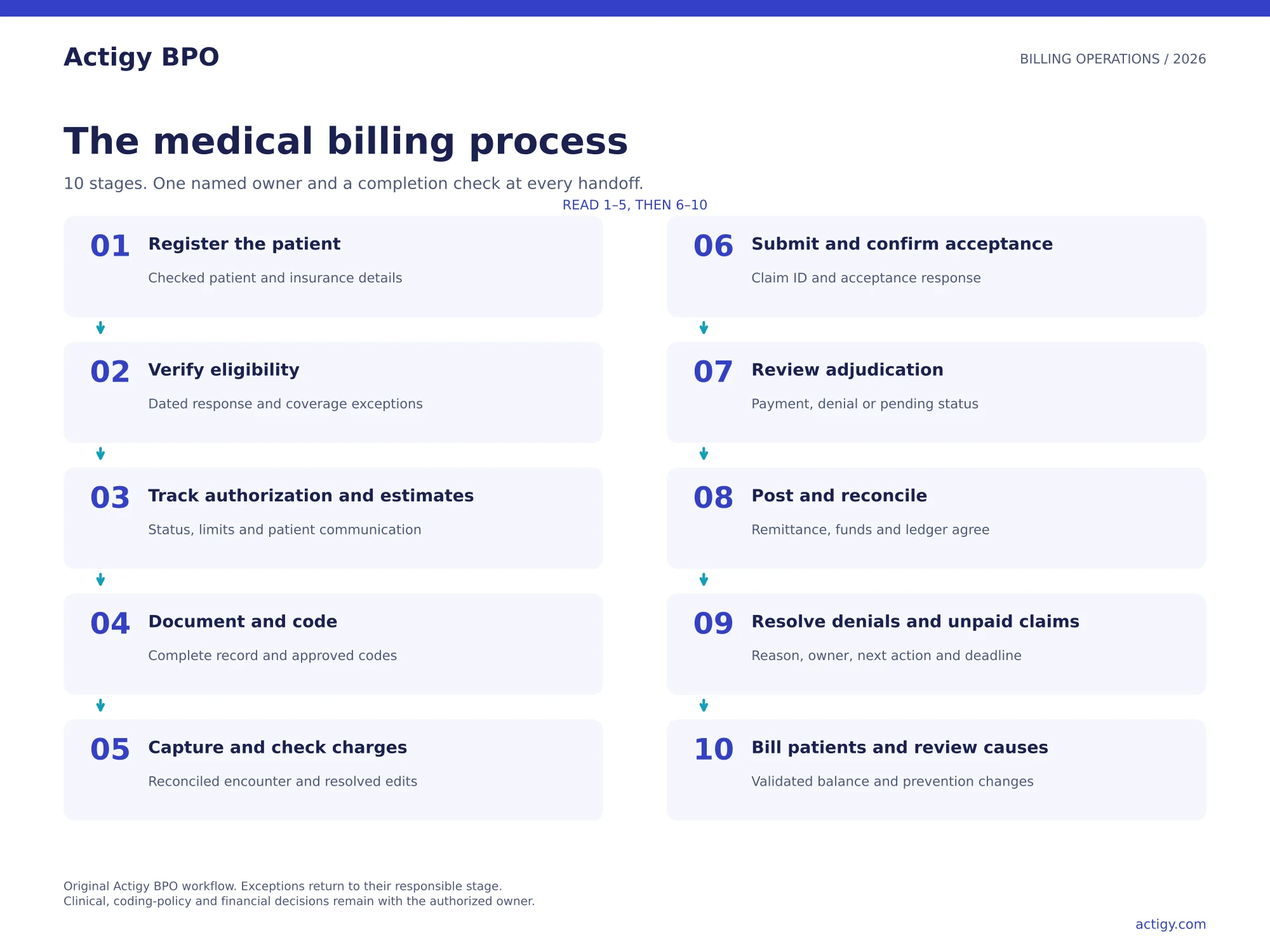
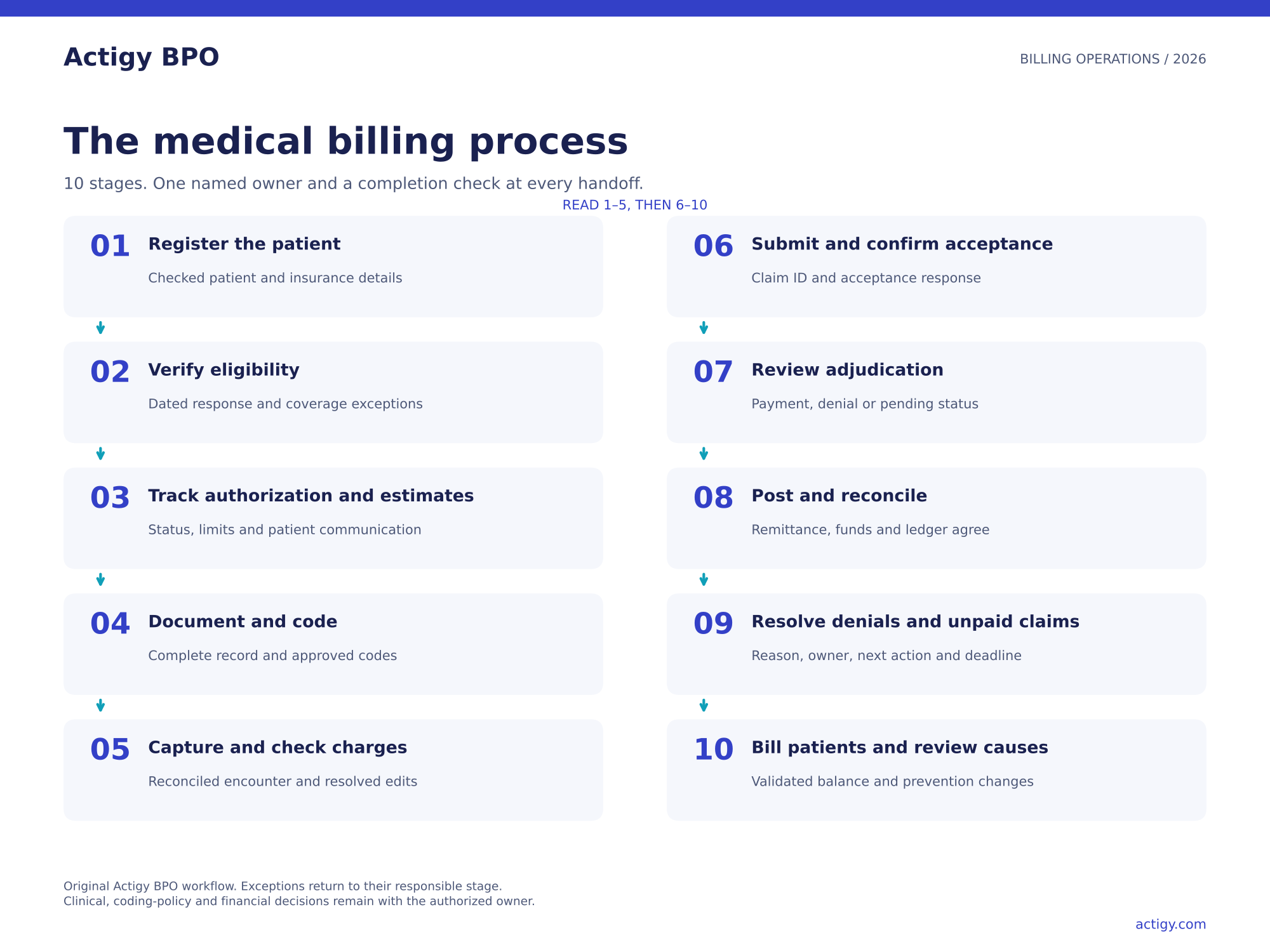
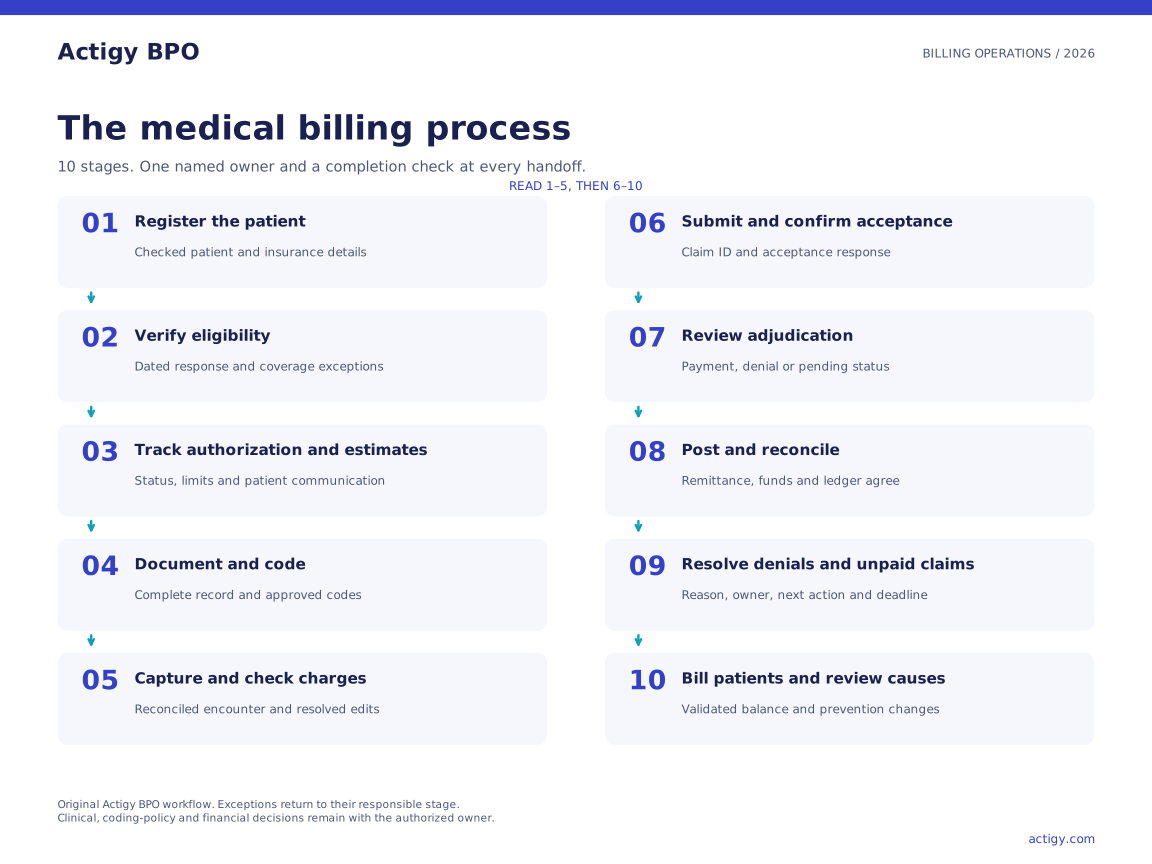
Clinical care determines the encounter. Billing checkpoints guide administrative work and escalation. They should never be used by an operations team to make independent care decisions.
What current research says about billing friction
Administrative automation has substantial value, but it does not remove the need to validate information and manage exceptions. The evidence below combines national transaction research with provider and patient surveys. The populations differ, so the percentages should not be combined into a single industry denial rate.
| Finding | Period and population | Operational meaning |
|---|---|---|
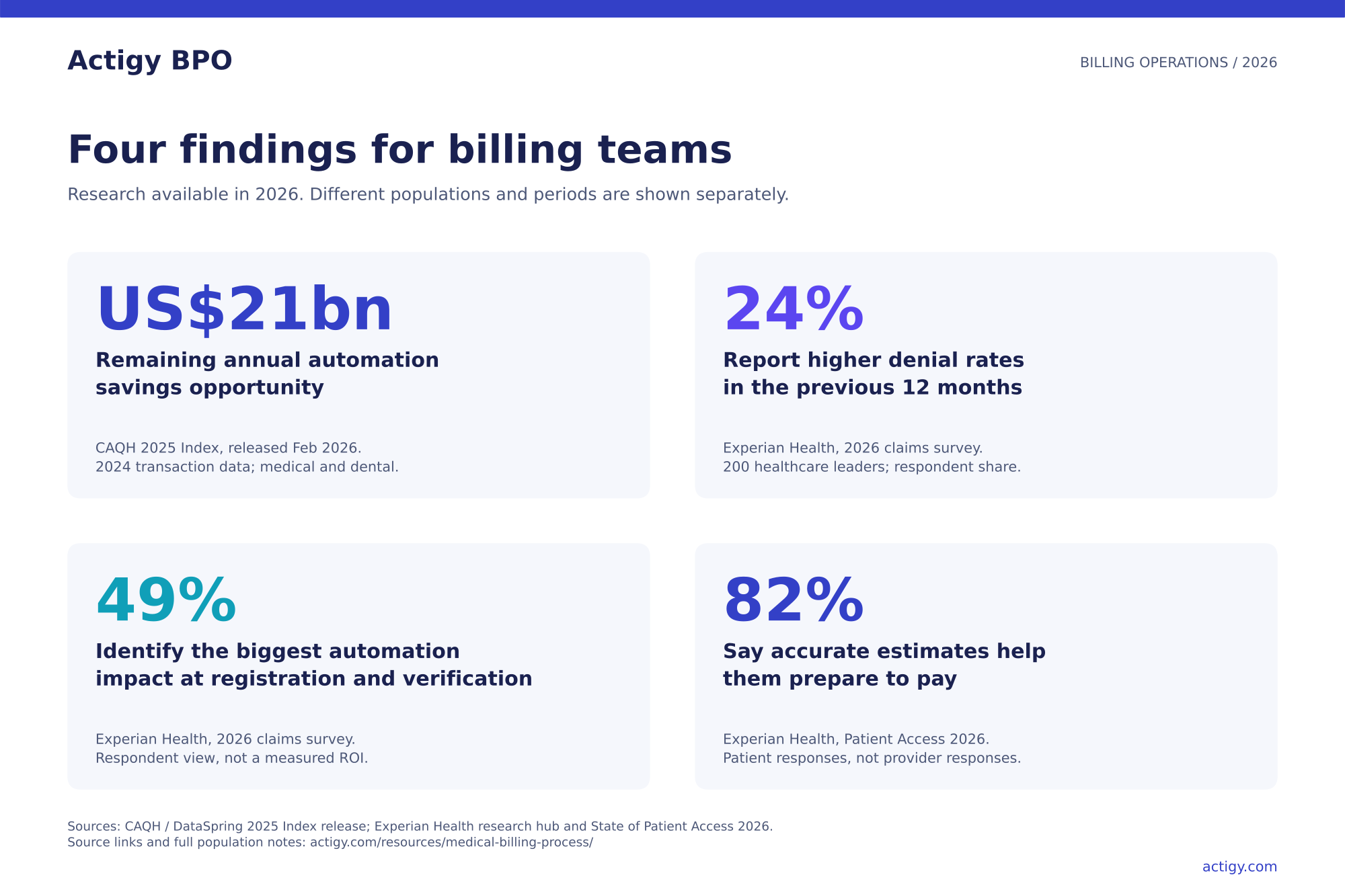
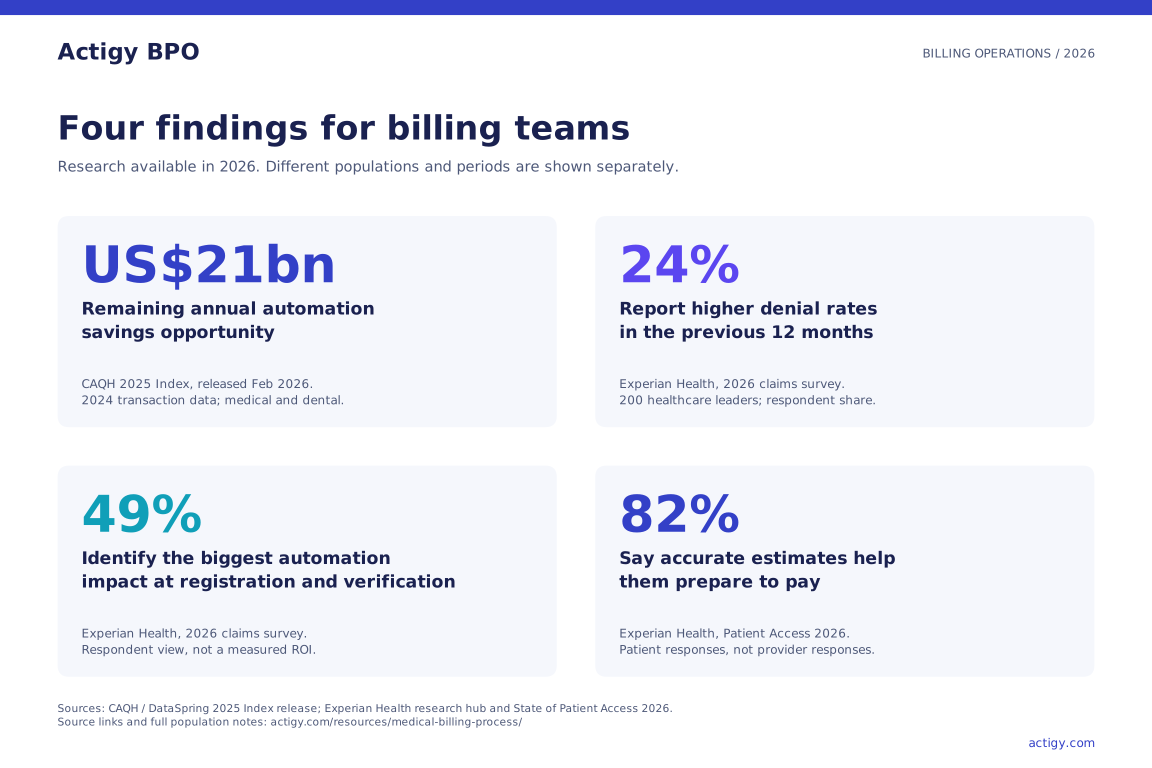
| $258 billion in estimated administrative costs avoided; $21 billion of remaining annual savings opportunity | 2024 activity in the 2025 CAQH Index, released February 2026 [S1] | Electronic transactions create value. The opportunity covers the measured transaction set, not just billing. |
| 17% increase in cost avoidance; 9% lower medical administrative spend | 2025 CAQH Index reporting on 2024 [S1] | Do not describe these as cost reductions achieved in 2026. |
| 24% report higher denial rates in the previous 12 months | 200 healthcare leaders surveyed January to February 2026 [S2] | A share of respondents reporting an increase, not a 24% claim denial rate. |
| 49% identify front-end registration and verification as the area where automation has the biggest impact | Same 2026 survey [S2] | Start process improvement where information enters the workflow. |
| 82% say accurate estimates help them prepare to pay | Patient responses in State of Patient Access 2026 [S3] | Explain likely responsibility early and label estimates clearly. |
| 68% have enabled online preregistration; 28% use AI to improve data collection | Provider responses in State of Patient Access 2026 [S3] | Digital intake and AI adoption are separate measures. |
| 41% report denial rates of at least 10% | 250 healthcare professionals in State of Claims 2025 [S4] | Historical survey context, not a measured national average. |
| 54% report increasing claim errors; 43% report understaffing | Same 2025 survey [S4] | Capacity and data quality both deserve attention. |
| 90% of denied-claim rework includes some human review | Same 2025 survey [S4] | Automation still needs an exception-review process. |
Sources: S1, S2, S3, S4. CAQH’s Index draws on more than 600 provider organizations and health plans representing 63% of insured lives. The patient-access survey includes more than 1,000 patients and 200 healthcare revenue cycle leaders. Vendor surveys describe their respondents and may not represent every provider.
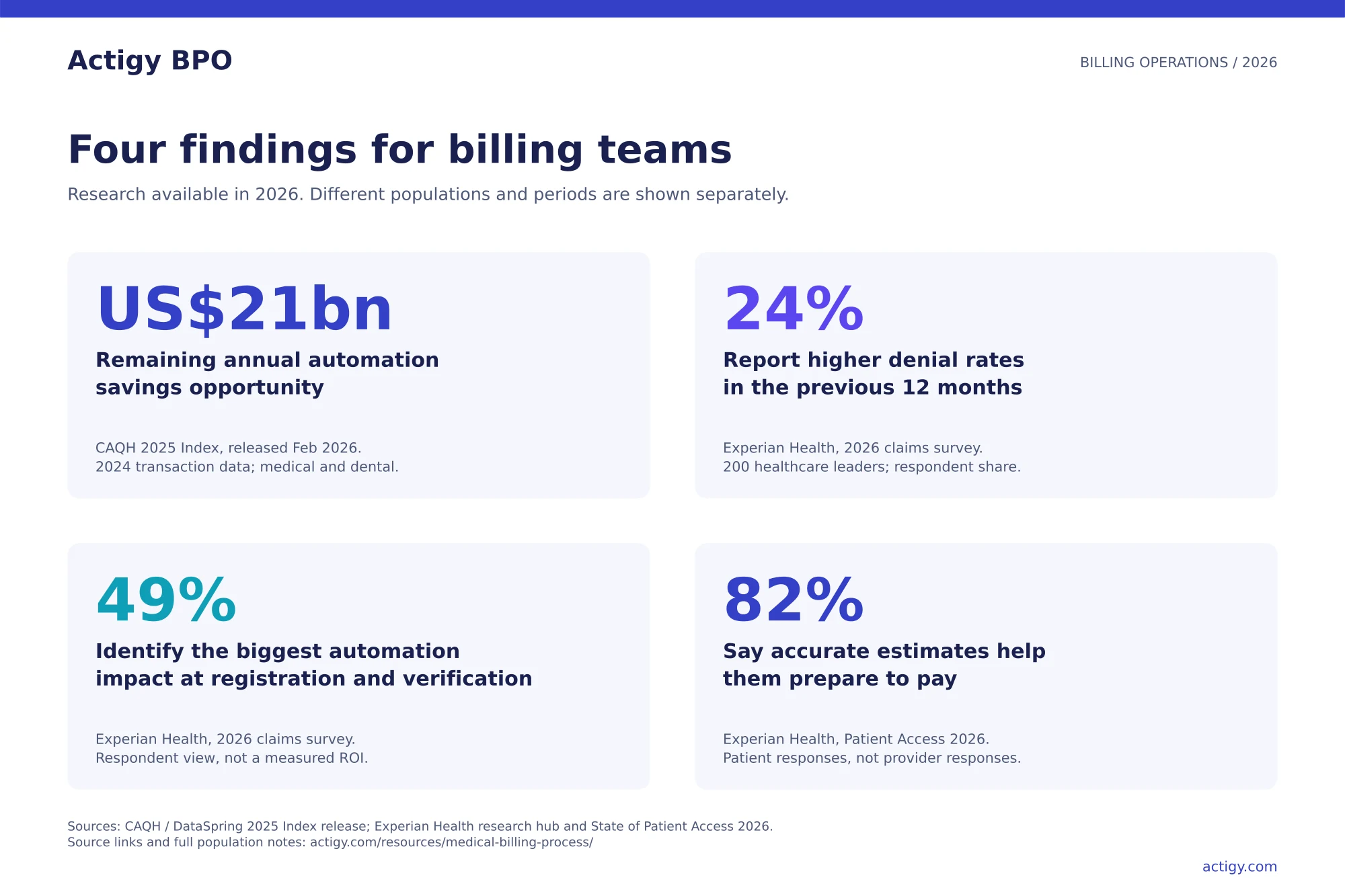
Actigy BPO’s reading of these findings is practical: improve the information entering the claim, then measure what happens after the handoff. Faster submission is useful only when the claim is accurate, accepted and followed through to a valid resolution.
New to the roles? Start with Actigy BPO’s billing and coding explainer. For management reporting across the wider cycle, use the RCM guide and operating worksheet.
The 10 steps in the medical billing process
1 Register the patient
Collect and confirm the patient’s demographic and insurance information. Check the member identifier, payer, subscriber relationship and contact details against current records. Returning patients also need an update when coverage or personal details change. A copied insurance record can preserve an old error for months.
The registration owner should record discrepancies and route them before the billing team uses the data. The completion check is a verified record or a clearly assigned exception, not merely a filled form. Track repeated corrections by field so training addresses the actual problem.
2 Verify insurance eligibility and benefits
Check active coverage for the intended service date, network status, relevant benefits and patient cost-sharing information. Record coordination-of-benefits questions, referral requirements and any limits the payer reports. Keep the response date and reference. An active policy does not establish that every planned service will be covered or paid.
Use a defined recheck rule when appointments move, coverage changes or information remains incomplete. Actigy BPO’s insurance eligibility verification service can support this queue in approved systems, with unresolved questions returned to the practice. The practice decides how to proceed with care and patient communication.
3 Check prior authorization and explain the estimate
Determine whether the planned service requires authorization or a referral. Where required, track the request, supporting records, status, authorized service, dates and any unit limits. An authorization request is not complete because it has been sent. Its current status must remain visible to scheduling and billing.
The CMS final rule introduced decision deadlines generally beginning in 2026 for specified payers: 72 hours for expedited requests and seven calendar days for standard requests. The timeframe requirement excludes QHP issuers on federally facilitated exchanges. These provisions address non-drug prior authorization, not a universal claim-payment deadline. API requirements generally begin in 2027. Check CMS scope and dates.
Give patients an understandable estimate and explain that it can change with actual services, coverage and payer processing. Prior authorization operations support can handle agreed administrative follow-up, while clinical justification remains with the provider. Authorization alone does not guarantee payment.
4 Document the encounter and assign codes
The clinician documents the care delivered. Qualified coding staff use that record to select the applicable diagnosis and procedure codes. Keep documentation queries visible until the responsible clinician resolves them. Do not infer a diagnosis, add an unsupported service or change a code solely to produce payment.
US billing still uses ICD-10-CM for diagnosis coding. CMS publishes FY 2027 files effective October 1, 2026. Use the correct release for the encounter or discharge date, including applicable midyear changes. ICD-10-PCS applies to inpatient hospital procedures, while CPT and HCPCS support other relevant services and supplies. CMS maintains the current code releases.
Where medical coding support is outsourced, define the specialty, reviewer and escalation rules separately from general billing work. A fast claim does not establish that the underlying coding is correct.
5 Capture charges and check the claim
Reconcile documented encounters to captured charges so completed services do not remain unbilled. Check required fields, provider information, dates, units, applicable modifiers, payer order and duplicate risk. Automated edits can flag inconsistencies, but passing those edits is not proof of coverage or medical necessity.
Maintain separate queues for missing documentation, coding review and administrative corrections. Record why a claim is held and who can release it. The useful measure is the time from a complete encounter record to a valid first submission, with reasons for delays available for review.
6 Submit the claim and confirm acceptance
Submit through the approved clearinghouse or payer route. Save the claim identifier, submission date and response. Electronic claims commonly use the X12 837 transaction. Eligibility inquiries and responses use 270/271, while claim-status inquiries and responses use 276/277 under the adopted standards. CMS lists the standards and operating rules.
A transmission receipt, a clearinghouse acceptance and a payer acceptance are different events. Confirm the relevant stage before reporting success. Route a rejected claim for correction and track the new response. Avoid submitting another original claim merely because an earlier claim is still pending.
7 Review payer adjudication
Adjudication is the payer’s review of a claim to determine payment, adjustments, patient responsibility or denial. Pending claims remain open work. Capture the payer’s actual status and reason rather than replacing them with an internal label such as “done.”
Compare the response with expected contract terms when those terms are available. A partial payment can contain a denied line or an underpayment that needs attention. Maintain line-level detail where necessary, while keeping claim-level reporting consistent.
8 Post payments and reconcile the account
Match the remittance to the payment and then to the correct account. Post approved payments, adjustments and patient responsibility. Investigate unmatched funds, unapplied cash and unexpected differences. Electronic remittance advice explains adjudication and adjustments; it is not itself proof that the money arrived. Medicare ERAs use X12 835. See CMS payment and remittance guidance.
Actigy BPO’s payment posting service supports ERA and EOB posting with defined checks. Refunds, write-offs and bank authority remain client decisions. Reconciliation should identify a residual balance or documented exception instead of forcing an account to zero.
9 Resolve denials and follow up on unpaid claims
Group work by actual status, reason, deadline and next action. A rejection may need corrected information. A denial may require a payer-specific correction, reconsideration or appeal. A claim awaiting adjudication needs status follow-up. Treating all three as the same queue creates wasted touches and duplicate submissions.
Keep the reason, evidence, responsible owner, next action date and filing or appeal limit together. Denial management addresses payer decisions and repeat causes. AR follow-up covers the wider unpaid balance queue, including pending claims and unmatched payments. Escalate clinical evidence and policy questions to the client owner.
10 Bill the patient and review recurring causes
Confirm that the remaining balance is actually the patient’s responsibility before issuing a statement. Explain the service, payment, adjustments and remaining amount in plain language. Provide a route to ask questions or discuss approved payment arrangements. Follow the applicable contract, assistance and collection policies.
Review credit balances and possible overpayments instead of leaving them outside the process. Authorized staff decide adjustments and refunds. Finally, connect recurring denials and corrections to registration, documentation or coding changes. The next reporting period should show whether the same problem is still entering the queue.
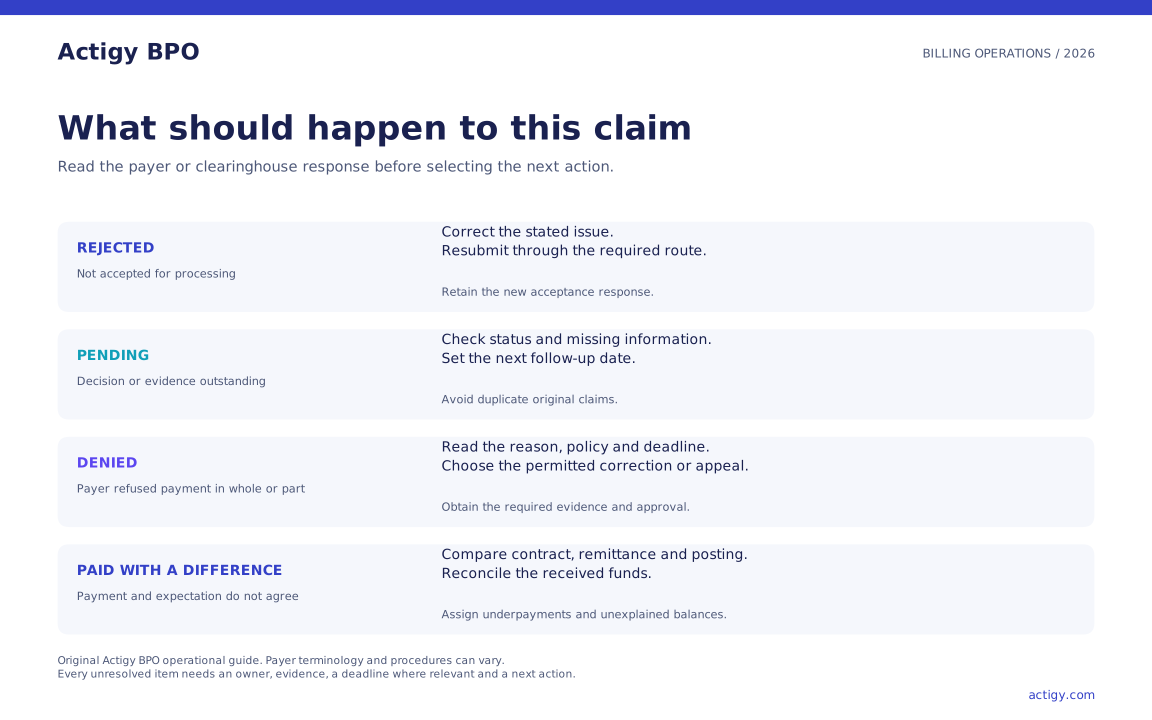
Rejected claims and denied claims need different actions
| Status | Meaning | Next action |
|---|---|---|
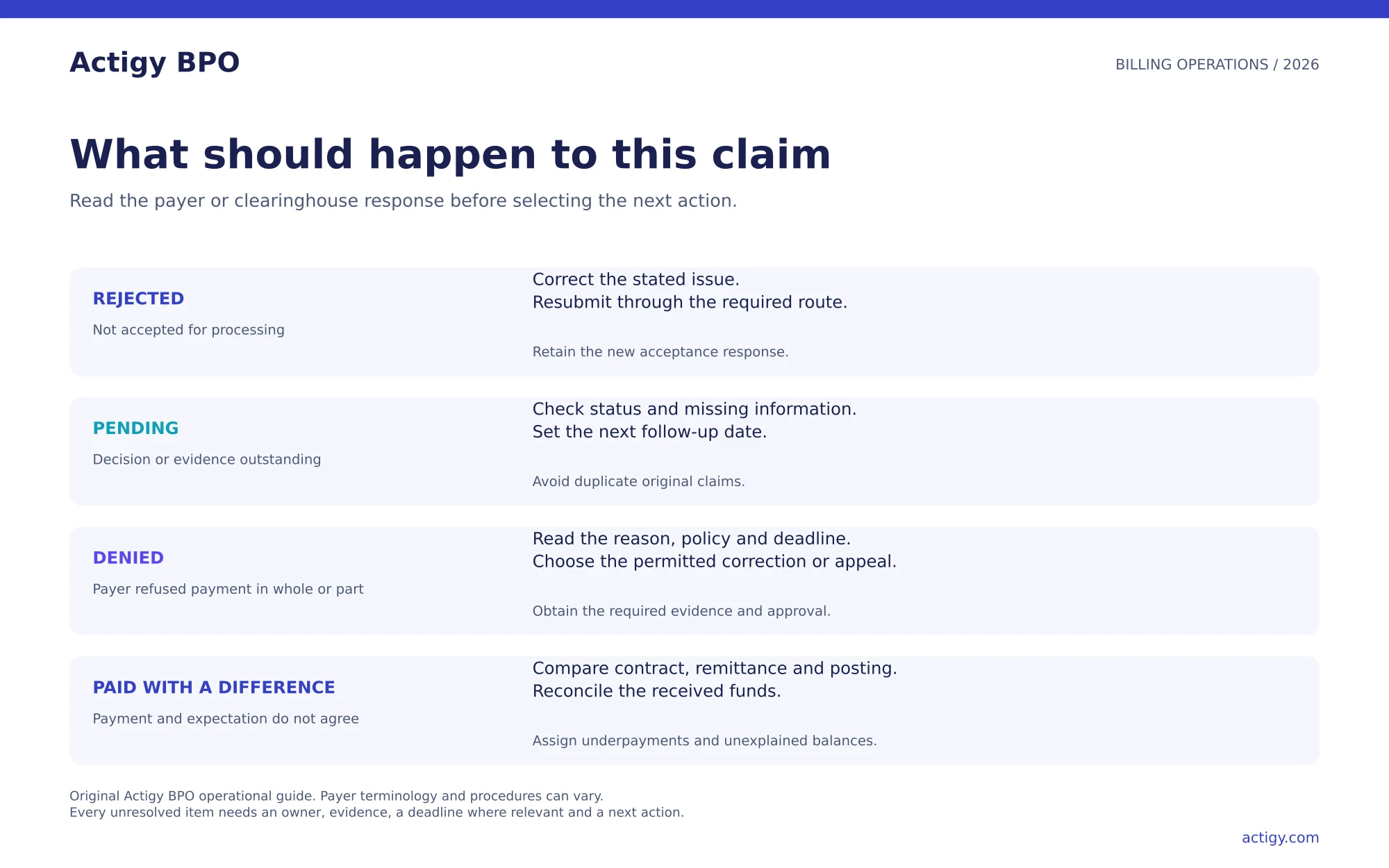
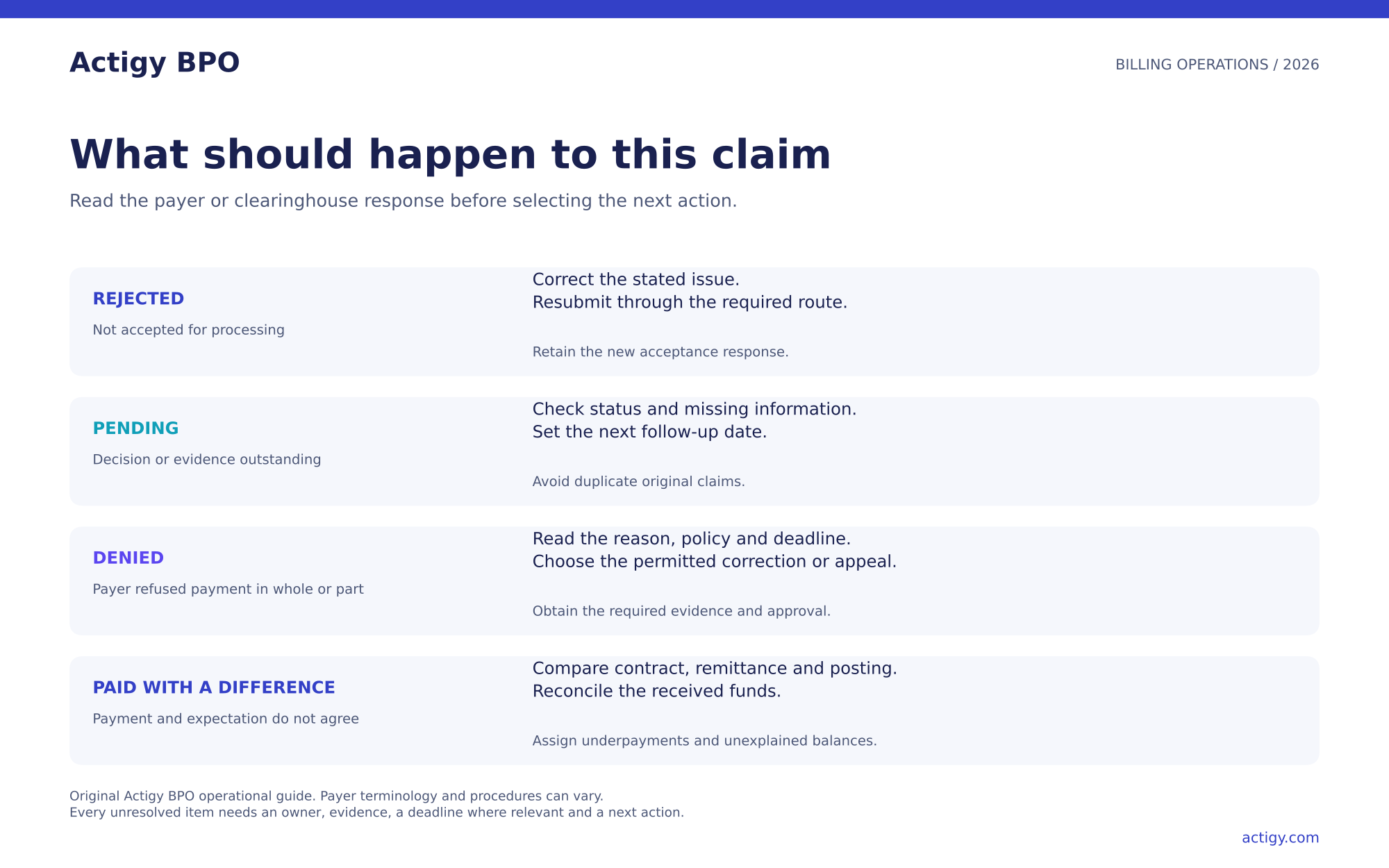
| Rejected | The claim was not accepted for processing at the relevant submission stage. | Correct the identified issue, resubmit through the required route and retain the response. |
| Denied | The payer adjudicated the claim or line and refused payment in whole or part. | Read the reason, policy and deadline. Use the permitted correction, reconsideration or appeal route. |
| Pending | The claim is received but a final decision or required information is outstanding. | Track status and missing evidence. Set a follow-up date without creating a duplicate original claim. |
| Paid with a difference | Payment does not reconcile with the expected amount or ledger. | Check contract terms, remittance, posting and funds before choosing the next action. |
These are operational distinctions. Payers can use different status labels and procedures. Always act on the actual payer response and applicable rules. A denial is not automatically a permanent loss, and a pending balance is not automatically a denial.
How to improve the medical billing process
Start with one recurring failure that the team can change. A broad automation rollout can make an unreliable process run faster without improving its result. The sequence below is Actigy BPO’s proposed improvement method, not a published industry benchmark.
1. Baseline the work. Select one payer or specialty and a defined period. Record counts, dollars, claim status, time spent and unresolved items. Keep the same definitions for the follow-up measurement.
2. Locate the source. Review a spread of successful and failed claims. Determine where each error entered the process. A denial discovered after submission may originate in registration or documentation.
3. Fix the handoff. Add the missing field, approval, evidence or exception owner to the procedure. Specify what happens when information is unavailable.
4. Test a limited change. Apply the revised procedure to one queue. Track both speed and error rates. Keep payer delays and missing client records separate from operator performance.
5. Confirm the outcome. Check later claims for recurrence. Review the retained staff time and total cost before expanding automation or external capacity.
When workload exceeds the internal team’s capacity, Actigy BPO medical billing outsourcing can be scoped around a defined queue. The process audit should establish what the work includes, which decisions stay with the practice and what the paid pilot must demonstrate.
The Actigy BPO Billing Control Scorecard
Define each metric before comparing results. Use the same claim population, measurement stage and time window. The scorecard below supplies working definitions for local adoption. It does not claim universal targets, and it should not be compared with another organization’s figures until the definitions match.
| Metric | Working definition | Use and caution |
|---|---|---|
| Eligibility completed on time | Scheduled visits with completed required checks before cutoff / visits requiring checks × 100 | Report unresolved exceptions separately. Do not count an unanswered request as verified. |
| First-pass acceptance | Original claims accepted at the named stage without correction / original claims submitted at that stage × 100 | Name clearinghouse or payer acceptance. Acceptance does not mean payment. |
| Initial denial rate | Unique claims with any denied line at first adjudication / unique claims first adjudicated in the cohort × 100 | Use claim counts, not denied dollars. Track line-level rates separately. |
| Denial recovery by dollars | Cash attributable to resolved denials / initially denied collectible dollars in the same matured cohort × 100 | Exclude contractual non-collectible amounts under a consistent approved policy. Report open balances. |
| Days in AR | Ending net patient-service AR / average daily net patient-service revenue | Use a consistent revenue window and matching accounting basis. Avoid mixing gross AR with net revenue. |
| AR older than 90 days | AR balance more than 90 days old / total AR balance on the same basis × 100 | Define aging from service or billing date. Separate credits and agreed exclusions. |
| Payment posting accuracy | Sampled postings without defined errors / all postings in the sample × 100 | Report sample size and error severity. A sample is not a census. |
| Rework hours | Total staff minutes on corrections and repeat touches / 60 | Include repeated touches consistently. Segment by cause and queue. |
For every row, the downloadable scorecard provides space for the baseline, current result, period, denominator, owner and next action. Leave a result blank when the underlying definition or data is missing. Record missing data as unavailable and assign an owner to resolve it.
For evidence on denied claims and a model that explicitly separates paid hours from active casework, see Actigy BPO’s claim denial statistics and rework model.
Calculate the labor cost of billing rework
Use your own time study to estimate the value of a process change. The model below covers labor time only. It does not estimate recovered claim revenue, financing cost, software cost or the probability that a payer will pay.
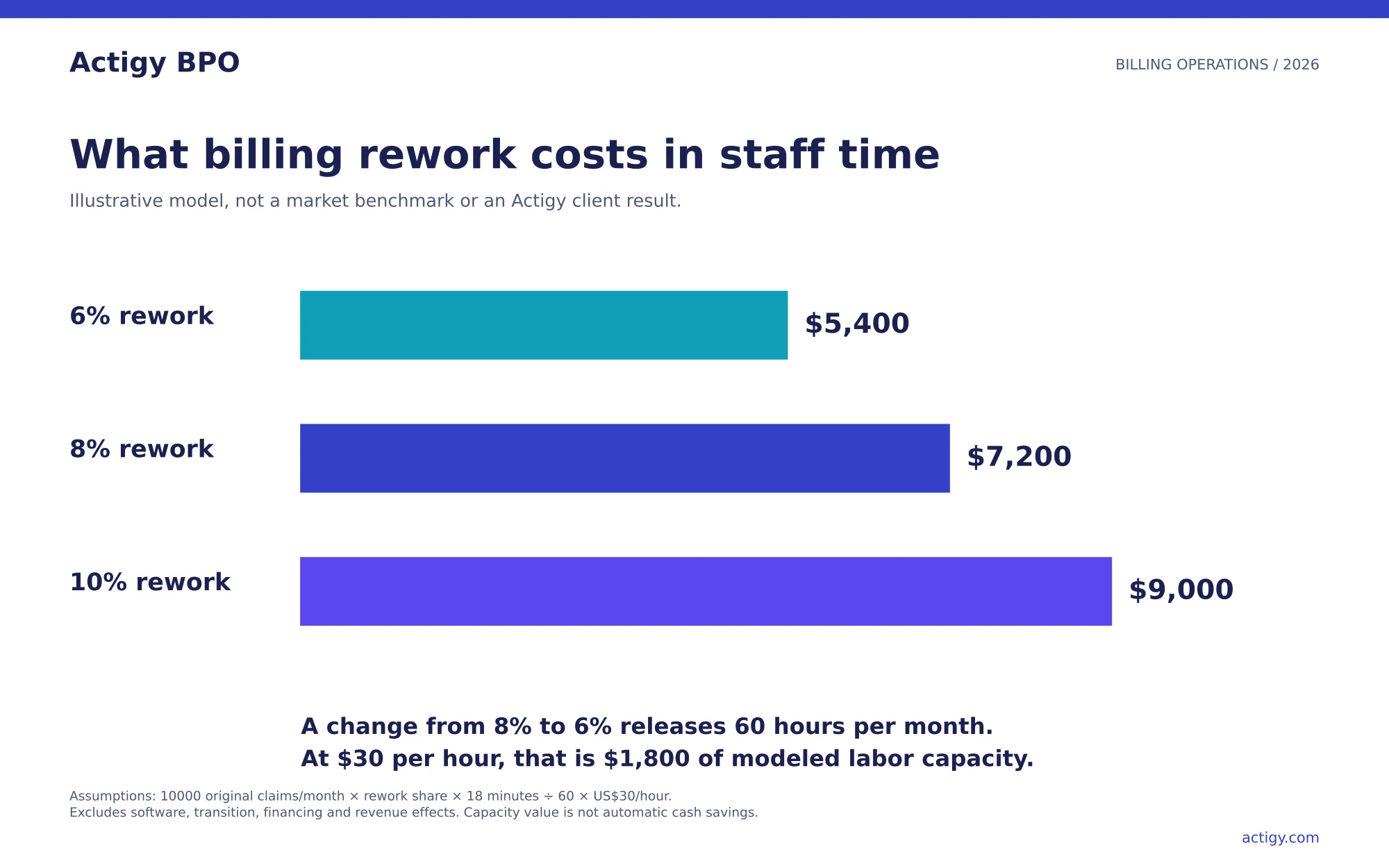
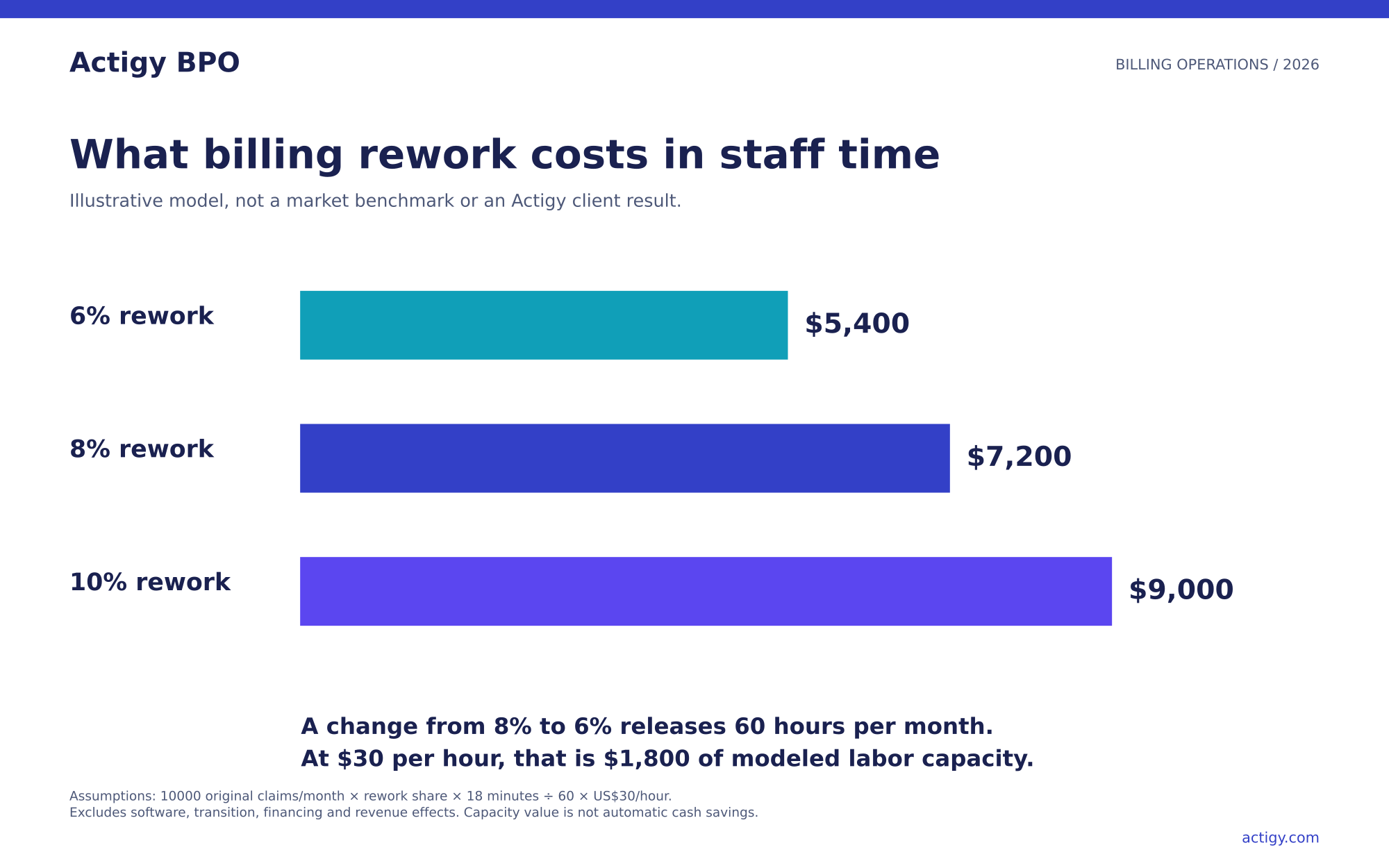
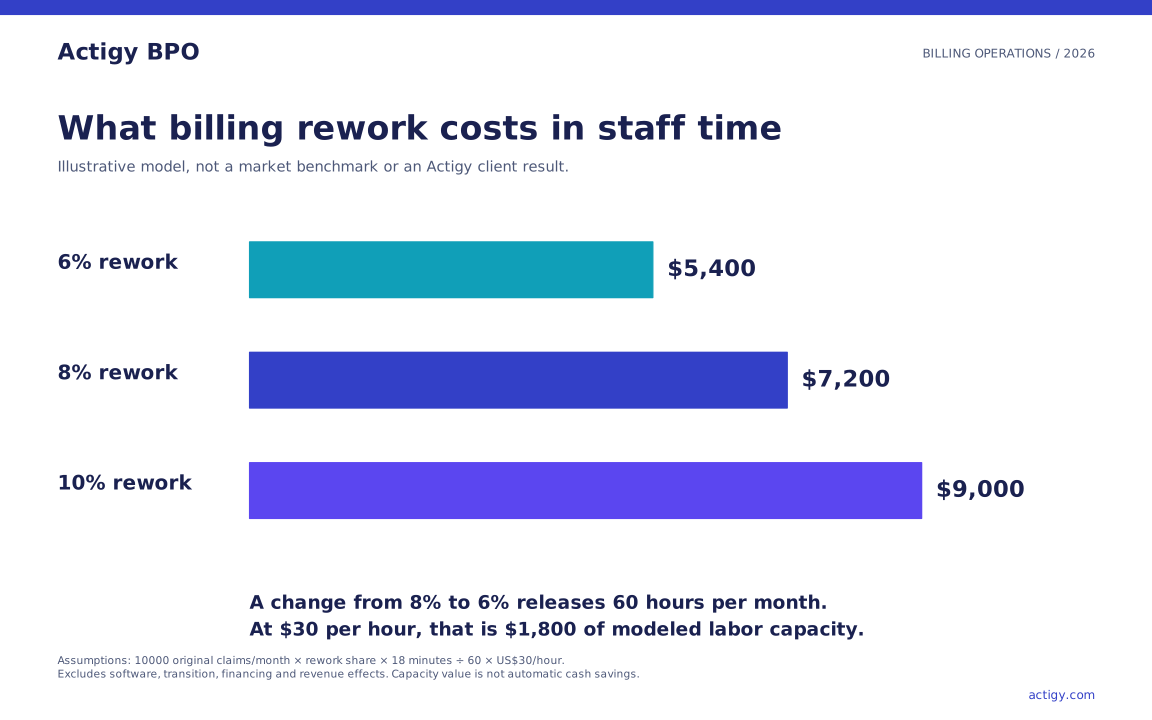
Monthly rework labor cost = original claims per month × share requiring rework × total minutes per affected claim ÷ 60 × effective cost per active rework hour.
Here, hourly cost means the effective cost of an active rework hour after allocating paid time that is unavailable for casework. If your payroll input is a cost per paid hour, divide it by the productive share before using this model. For example, $24 per paid hour at 80% productive time becomes $30 per active hour.
| Illustrative input | Value |
|---|---|
| Original claims per month | 10,000 |
| Share requiring rework | 8% |
| Total rework minutes per affected claim | 18 |
| Effective cost per active rework hour | US$30 |
| Calculated monthly rework time | 240 hours |
| Calculated monthly rework labor cost | US$7,200 |
If the rework share falls from 8% to 6% with the other inputs unchanged, the model releases 60 staff hours, valued at $1,800 per month. That is capacity value. It becomes a cash saving only if actual paid costs fall. The 8%, 6%, 18 minutes and $30 inputs are illustrative assumptions, not market benchmarks or an Actigy BPO result.
Apply the model to your queue
Illustrative defaults. Calculations run in your browser. No patient information is needed.
With the illustrative defaults, baseline rework is 240 hours and $7,200 per month. The target is 180 hours and $5,400. The difference is 60 hours and $1,800 of capacity value.
Capacity value is not automatic cash savings. The model excludes technology, transition, financing and revenue effects.
A 20-point audit for the billing workflow
Use the Actigy BPO Billing Control Checklist on a defined queue. Mark each control Yes, Partial, No or Not applicable, and attach evidence. Review failures individually rather than converting them into an unsupported compliance score.
1. Patient identifiers and payer details are checked against current information.
2. Eligibility evidence includes the service date and response date.
3. Benefits, payer order and unresolved coverage questions are recorded.
4. Authorization requirements, status, dates and units are visible where applicable.
5. Patient estimates are explained and identified as estimates.
6. Documentation queries have a clinical owner and remain visible.
7. Coding uses the applicable release and has a defined review path.
8. Completed encounters are reconciled to captured charges.
9. Claim edits and possible duplicates are resolved before release.
10. Submission identifiers and acceptance or rejection responses are retained.
11. Pending claims have a next action date and an accountable owner.
12. Denial reasons and filing or appeal deadlines are recorded.
13. Corrections and appeals follow payer-specific rules.
14. Remittances, received funds and posted payments are reconciled.
15. Underpayments, unapplied cash and credit balances are assigned.
16. Refunds and write-offs require the appropriate approval.
17. Patient statements reflect a validated responsibility amount.
18. Access, approved locations and applicable agreements are documented.
19. KPI denominators, periods and exclusions are written down.
20. Repeat errors result in a documented process change and follow-up review.
Resolve missing ownership, untracked deadlines and unexplained financial differences first. This checklist is an operational review aid. It is not a coding certification or a substitute for payer requirements.
Where Actigy BPO fits in the workflow
Actigy BPO supports defined billing operations in client-approved systems. The best starting point is a repeatable queue with accessible evidence, clear procedures and an approval owner. The following scenarios describe operational fit, not a claim that one provider is best for every practice.
| Your situation | Relevant Actigy BPO scope | What the client retains |
|---|---|---|
| Eligibility work falls behind the appointment schedule | Eligibility verification with documented exceptions | Care decisions and unresolved coverage policy |
| Authorization requests lack reliable follow-up | Prior authorization support for submission records and status tracking | Clinical evidence and justification |
| Denied claims age without a next action | Denial management with reason, deadline and escalation ownership | Clinical review, coding policy and appeal approvals |
| Remittances and the ledger do not reconcile | Payment posting and exception handling | Bank authority, write-offs and refunds |
| Old balances compete with current claims | AR follow-up with separate pending and denied worklists | Settlement rules and financial approvals |
| A billing company needs capacity while retaining its client relationships | Support for healthcare billing and RCM companies under client-specific procedures | Client contracts, service promises and account oversight |
For a broader scope, revenue cycle management outsourcing connects multiple queues under shared reporting. Small, irregular workloads may fit an individual biller better. Work cannot start where required records, approvals or permitted access are unavailable.
HHS identifies billing and claims administration involving protected health information as examples of business associate functions. Confirm the required agreements and safeguards before granting access. Review permitted locations, individual accounts, logging and incident procedures with the responsible compliance team. HHS business associate guidance provides the underlying requirements.
Actigy BPO reported outcomes
Actigy BPO reports that a combined telehealth revenue-cycle engagement increased clean claims from 84.1% to 97.8%, a gain of 13.7 percentage points. Days sales outstanding fell from 48 to 33 days, a reduction of 15 days or 31.25% calculated from the displayed figures. The work combined eligibility, coding, billing, denials and AR follow-up.
The full telehealth RCM case study is anonymized and company-reported, with no independent audit or disclosed engagement dates. It does not isolate the effect of any one service or predict another practice’s result. Compare the scope and metric definitions before using it in a business case.
Need help with one of these queues? Scope a billing pilot with Actigy BPO. Share the claim volume, payer mix, systems, backlog and outcome the pilot should test. Use aggregate information in the inquiry and keep patient records in approved channels.
Related Actigy BPO guides
Compare billing and coding responsibilities
Compare denial benchmarks and rework costs
Medical billing process questions
What is the difference between medical billing and revenue cycle management?
Medical billing focuses on preparing and tracking claims, recording payments and resolving balances. Revenue cycle management is the wider financial process, including access, revenue capture and performance oversight. The functions overlap, so a service agreement should name the actual tasks rather than relying on the label.
What are the 10 steps in the medical billing process?
The Actigy BPO workflow groups the work into registration, eligibility, authorization and estimates, documentation and coding, charge checks, submission, adjudication, posting, denial and AR follow-up, and patient billing with review. The number is a practical grouping, not a universal regulatory standard.
How long does the medical billing process take?
There is no single duration across payers, services and claim conditions. Measure documentation delay, time to first submission, payer processing time and final payment separately. The CMS prior-authorization response deadlines discussed here do not establish a general billing-cycle completion time.
What is a clean claim?
A clean claim satisfies the applicable completeness and processing requirements at the stage being measured. A software clean-claim score, clearinghouse acceptance and payer first-pass acceptance may use different rules. Define the stage before comparing rates. Acceptance alone does not establish payment or coding accuracy.
Can AI automate the entire medical billing process?
Automation can assist intake checks, routing, status work and draft preparation. Its output still needs validation against source records, payer rules and approved procedures. Keep human review for exceptions and the required clinical, coding and financial decisions. A successful demonstration does not establish reliable performance across an entire payer mix.
Can a practice outsource only part of medical billing?
Yes. Actigy BPO can scope a specific queue such as eligibility, denial follow-up or payment posting. Written procedures should define handoffs, permitted access, reporting and retained decisions. A bounded paid pilot provides a way to test the arrangement before adding volume.
Is the workflow available as a PDF?
Yes. The free Actigy BPO Billing Control Toolkit contains a printable workflow, a 20-point audit and a blank KPI scorecard. Use it to review a queue with your billing lead and retain the source and version when sharing it.
Download the Actigy BPO working files
Download the Billing Control Toolkit PDF
For claim-by-claim handoffs, the separate editable Actigy BPO claim control and exception log (Word) records the current stage, evidence, next owner and closure check. Keep patient records in the approved system.
Sources and methodology
Actigy BPO reviewed the linked research and guidance on October 18, 2026. This article synthesizes published evidence and introduces an original workflow, checklist and working scorecard. It does not present a new survey of providers. Publication year, observation period and respondent population are stated separately. Survey findings, transaction estimates, illustrative calculations and company-reported outcomes are distinct evidence types.
The operational guidance is intended for administrative process design. Apply current payer policies, contracts, coding guidance and professional review to individual claims. Material changes to source data or rules should trigger an update to this page and its downloadable toolkit.
S1. CAQH 2025 Index release. DataSpring formerly CAQH. 2026-02-19. 2024 administrative transactions; more than 600 provider organizations; health plans representing 63% of insured lives.
S2. Healthcare Industry Research and 2026 claims denial survey. Experian Health. 2026; fieldwork January to February. 200 healthcare leaders; survey responses, not a claims census.
S3. State of Patient Access 2026. Experian Health. 2026. More than 1,000 patients and 200 healthcare revenue cycle leaders; patient and provider results have different denominators.
S4. State of Claims 2025 release. Experian Health. 2025-09-22. 250 healthcare professionals responsible for financial, billing or claims decisions.
S5. CMS Interoperability and Prior Authorization Final Rule CMS-0057-F. CMS. 2024-01-17; operational provisions generally 2026. Impacted payers and non-drug services; timeframe provision excludes QHP issuers on federally facilitated exchanges.
S6. ICD 10 code releases. CMS. FY 2027 releases effective 2026-10-01. Use the applicable diagnosis or procedure code release for the encounter or discharge date.
S7. Adopted Standards and Operating Rules. CMS. Current resource accessed 2026-10-18. HIPAA administrative transaction standards.
S8. Health Care Payment and Remittance Advice. CMS. Current resource accessed 2026-10-18. Medicare electronic remittance advice and the X12 835 format.
S9. Business Associates. HHS. Current resource accessed 2026-10-18. HIPAA business associate functions and contractual safeguards.
S10. Telehealth RCM case study. Actigy BPO. Accessed 2026-10-18; engagement dates not disclosed. Anonymized company-reported combined billing engagement; not independently audited.
Suggested citation: Actigy BPO. Medical billing process in 10 steps with a free checklist. Research checked October 18, 2026. https://actigy.com/resources/medical-billing-process/
Reuse note: You may share the original Actigy BPO workflow, checklist and graphics with visible attribution and a link to this guide. Keep source notes and qualifiers with the visuals. Underlying third-party research remains credited to its publisher.