Healthcare Revenue Cycle Management Guide 2026
Published · Last updated
Revenue cycle management in healthcare connects the care a provider delivers with the money it is entitled to collect. The work starts before an appointment and continues through documentation, claims, payment reconciliation and unresolved balances. A clean claim is one milestone. It is not proof that the provider received the correct payment or kept it.
Actigy BPO created this guide for practice managers, revenue cycle leaders and billing companies reviewing the full encounter-to-payment process. Use the control map to assign handoff owners, then use the operating worksheet to connect workflow measures with reconciled financial outcomes. The research table retains each source’s population and measurement period.
What is revenue cycle management in healthcare?
Revenue cycle management, or RCM, is the coordinated administrative and financial work that turns a patient encounter into an accurate, resolved account. It includes registration, eligibility, authorization, documentation, coding, claim submission, payment posting, denial handling and patient billing. Actigy BPO’s RCM Control Map adds an owner, completion evidence and an escalation route to each handoff.
The definition is consistent with HFMA’s overview of healthcare revenue cycle management. The operating map below is Actigy BPO’s editorial framework, rather than an industry certification or a new national benchmark.
The essentials
- RCM is broader than medical billing. It connects pre-visit work, clinical documentation and post-payment review.
- Published statistics measure different things. A survey of provider opinions is not a count of denied claims.
- Assess both workflow quality and cash outcomes. Fewer denials do not automatically mean more money retained.
- Name the owner of every exception. A task marked complete can still leave the next team unable to act.
- Keep clinical decisions, coding policy and financial approvals with the authorized people.
Why revenue cycle management matters in 2026
An RCM operation can look busy while collections deteriorate. Staff may clear tickets, resubmit claims and post payments without resolving the reasons money is delayed. The useful question is whether each action moves an account toward a correct, documented resolution.
The scale of administrative friction is substantial. The 2025 CAQH Index, released in February 2026, estimates that electronic transactions avoided $258 billion in US administrative costs in 2024, with another $21 billion potentially available through fuller automation. These are industry estimates, not savings that an individual provider can assume.
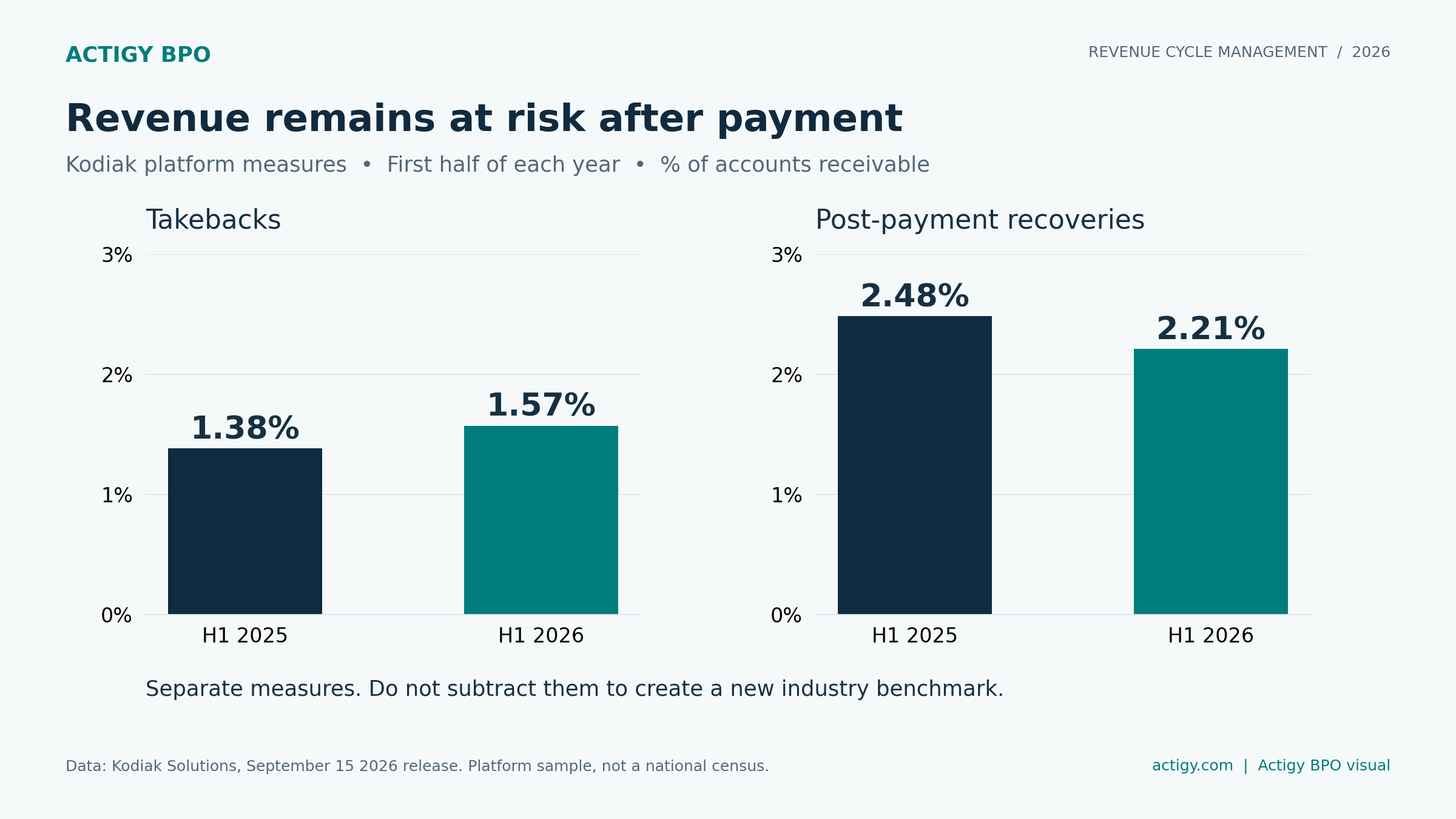
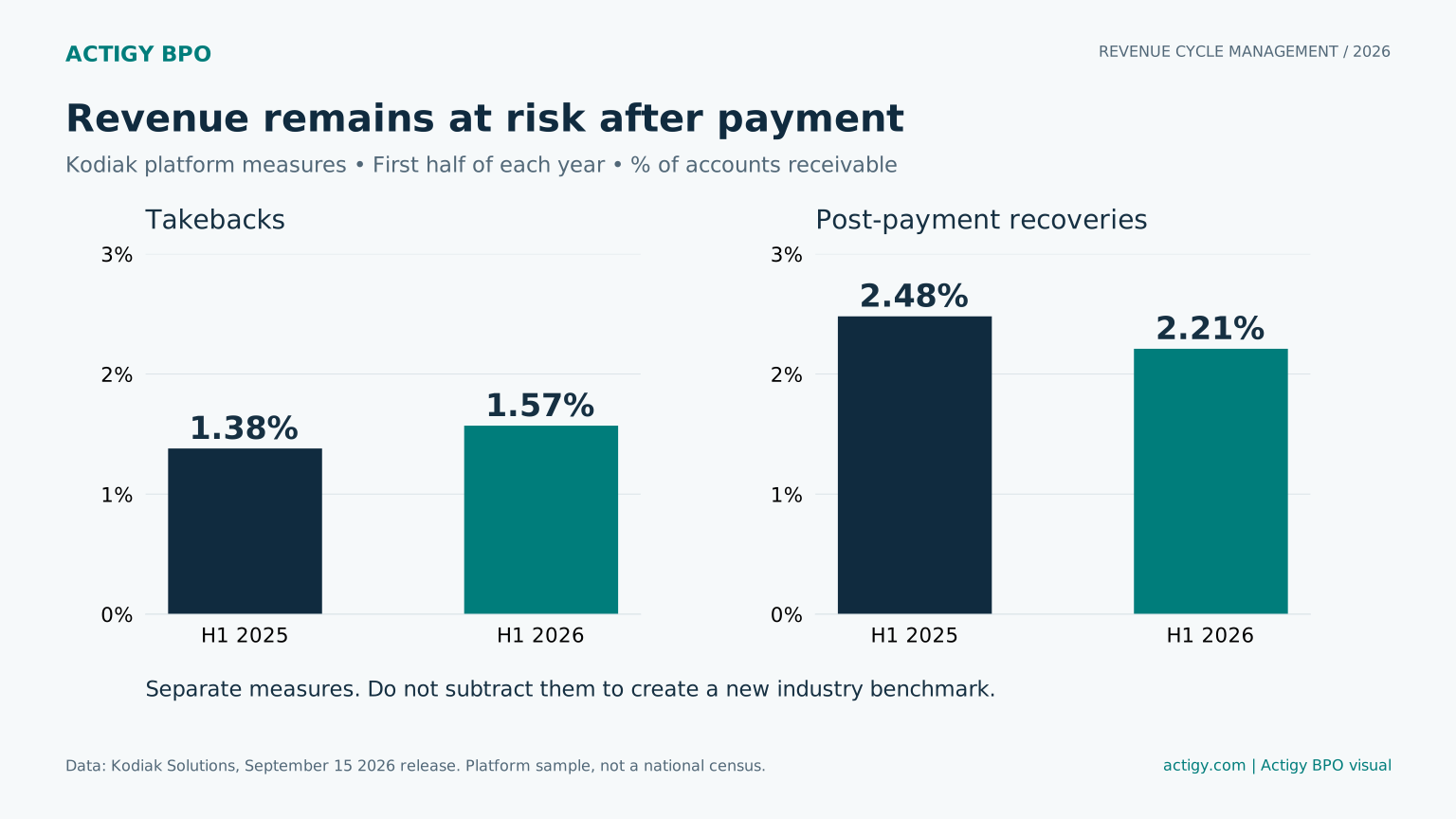
More recent claims evidence challenges the idea that denial rate alone describes performance. In its September 2026 release, Kodiak reported that overall initial and final denial rates improved in the first half of 2026, while higher takebacks and weaker recoveries offset progress. The analysis covered more than 2,300 hospitals and 375,000 physicians on its platform. It is a platform sample, not a census of US providers.
For an operator, the implication is practical: review the account after payment as well as before it. Reconcile allowed amounts, adjustments, recoupments and unresolved patient responsibility. Otherwise, a better front-end dashboard can conceal a weaker final result.
Revenue cycle statistics with dates and definitions
Actigy BPO’s evidence table preserves the year and population behind each finding. Use it to frame questions for your own operation. Do not combine the percentages into an average denial rate or treat them as universal targets.
| Finding | Evidence and period | What it measures |
|---|---|---|
| $258 billion in avoided administrative cost | CAQH 2025 Index, released February 2026, using 2024 data | Estimated effect of electronic transactions across US healthcare [1] |
| $21 billion in remaining savings opportunity | Same CAQH release | Estimated opportunity from further automation, not guaranteed provider savings [1] |
| 9% lower medical administrative spending | Same CAQH release | Change in the medical administrative spending measure, not total healthcare spending [1] |
| 48% named denials and appeals as their largest revenue cycle leak | MGMA poll, January 6 2026, 288 applicable responses | Share of respondents selecting a problem, not share of revenue lost [2] |
| 40 prior authorizations per physician per week | AMA 2025 survey, released May 2026, 1,000 physicians | Average reported authorization workload [3] |
| 13 hours per week spent on prior authorization | Same AMA survey | Combined physician and staff time, not 13 physician-only hours [3] |
| 41% reported denial rates of at least 10% | Experian State of Claims 2025, 250 respondents | Share of surveyed professionals reporting that threshold [4] |
| 43% reported understaffing | Same Experian survey | A reported staffing condition, not a vacancy rate [4] |
| 50% identified missing or inaccurate data as a denial reason | Same Experian survey | Survey response, not 50% of all denied claims [4] |
| 24% reported increasing denial rates | Experian research hub, January-February 2026 survey of 200 leaders | A separate survey and question from the 2025 threshold finding [5] |
| 49% said automation had its biggest impact in registration and verification | Same 2026 research summary | Respondent assessment of where automation helps [5] |
| 88% placed payer challenges among their top three concerns | Guidehouse/HFMA 2026 report, 191 executives surveyed in late 2025 | Executive priorities, predominantly hospitals and health systems [6] |
| 19.7% reported final denial rates above 5% | Same Guidehouse/HFMA report | Distribution of self-reported final denial rates [6] |
| Takebacks rose from 1.38% to 1.57% of accounts receivable | Kodiak, first half 2025 versus first half 2026 | Published takeback measure, not a count-based claim denial rate [7] |
| Post-payment recoveries fell from 2.48% to 2.21% of accounts receivable | Same Kodiak comparison | Published recovery measure, distinct from initial payment performance [7] |
Sources: 1 CAQH, 2 MGMA, 3 AMA, 4 Experian 2025, 5 Experian 2026 research, 6 Guidehouse and HFMA, 7 Kodiak release.

Where practice leaders see the largest leaks
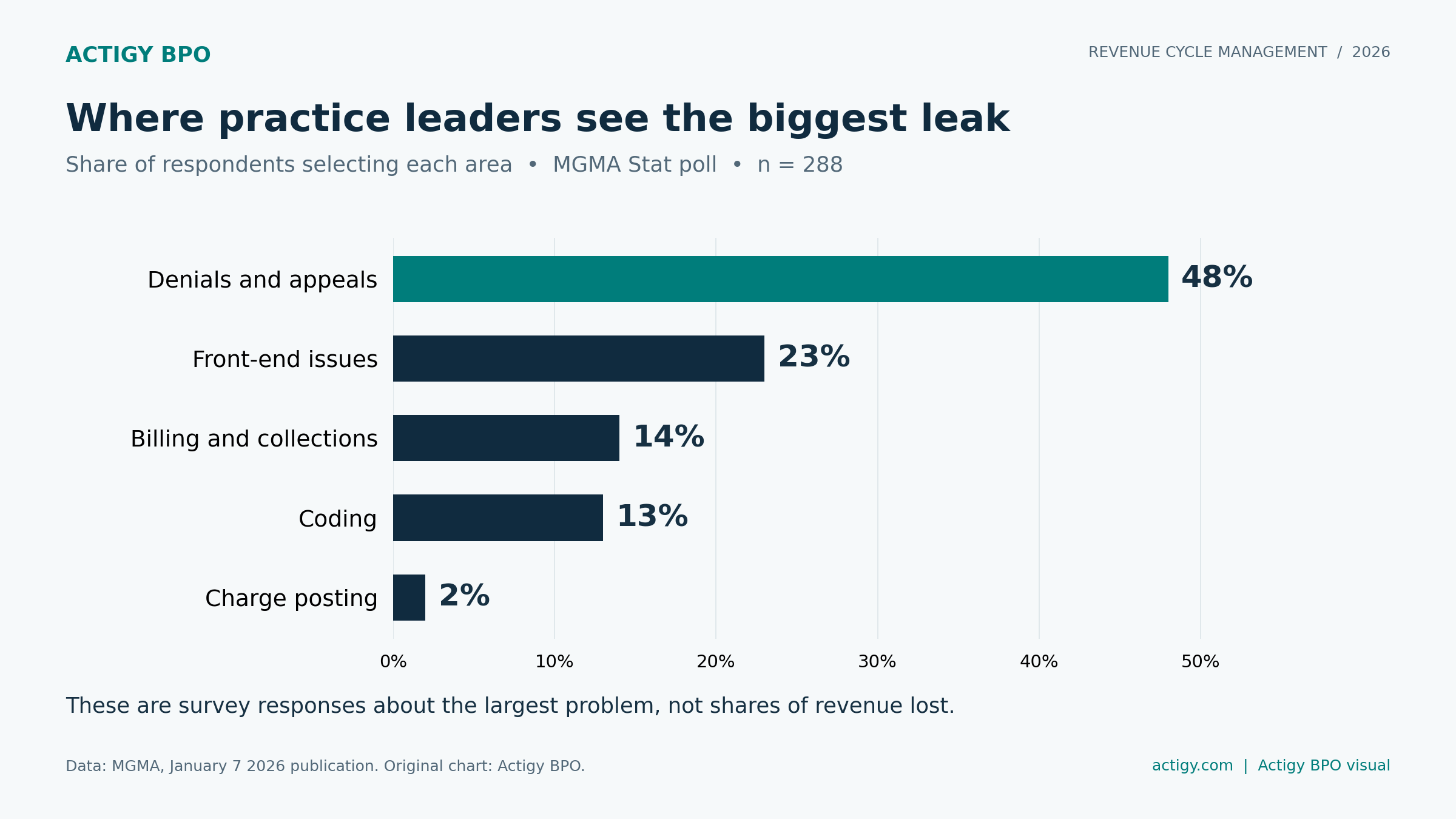
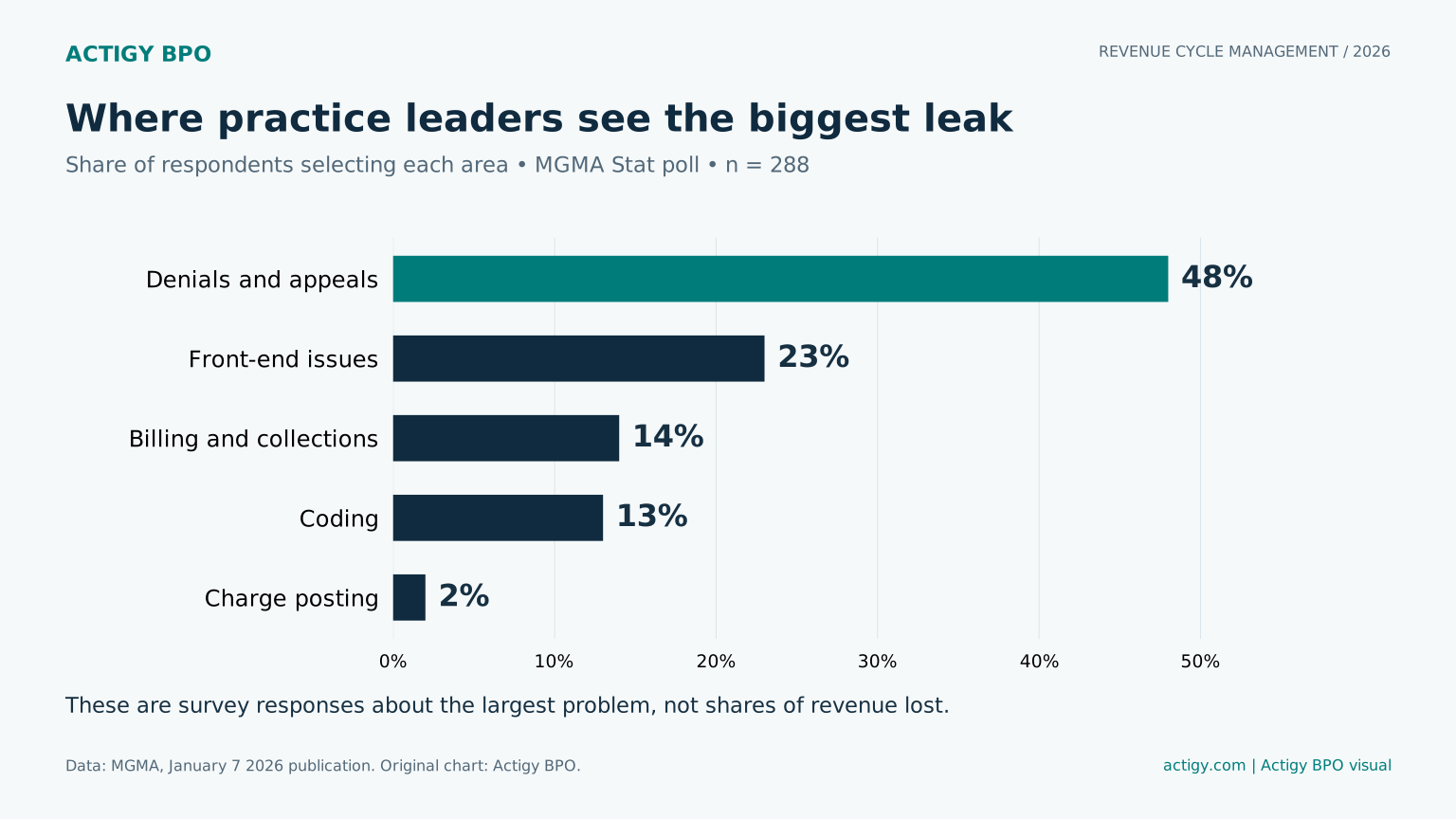
MGMA’s January 2026 poll is useful for prioritization, provided its denominator stays visible. Denials and appeals led at 48%, followed by front-end issues at 23%, billing and collections at 14%, coding at 13%, and charge posting at 2%. These are answers from 288 respondents about their largest problem. They do not describe the distribution of lost dollars.

How the healthcare revenue cycle works
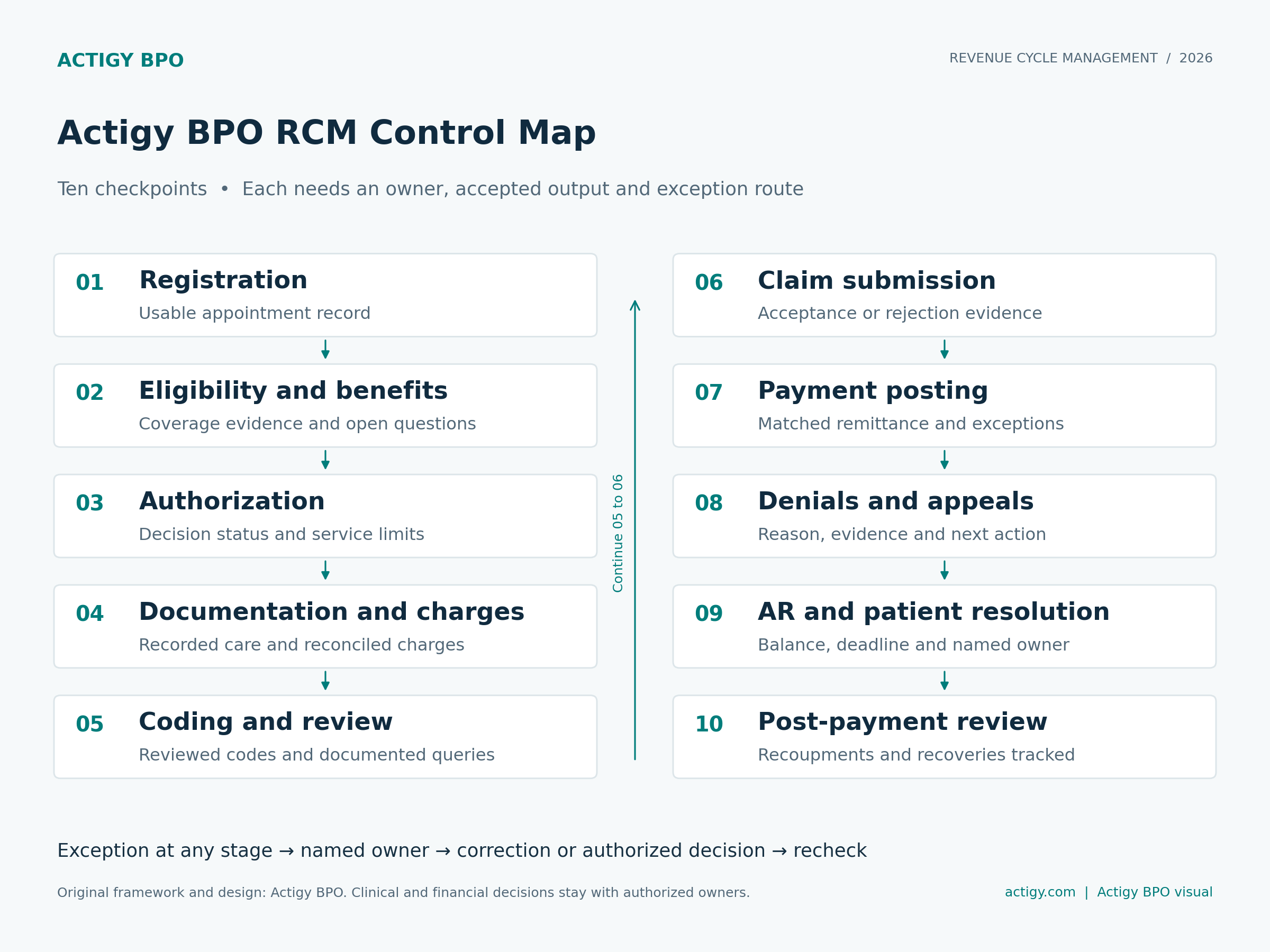
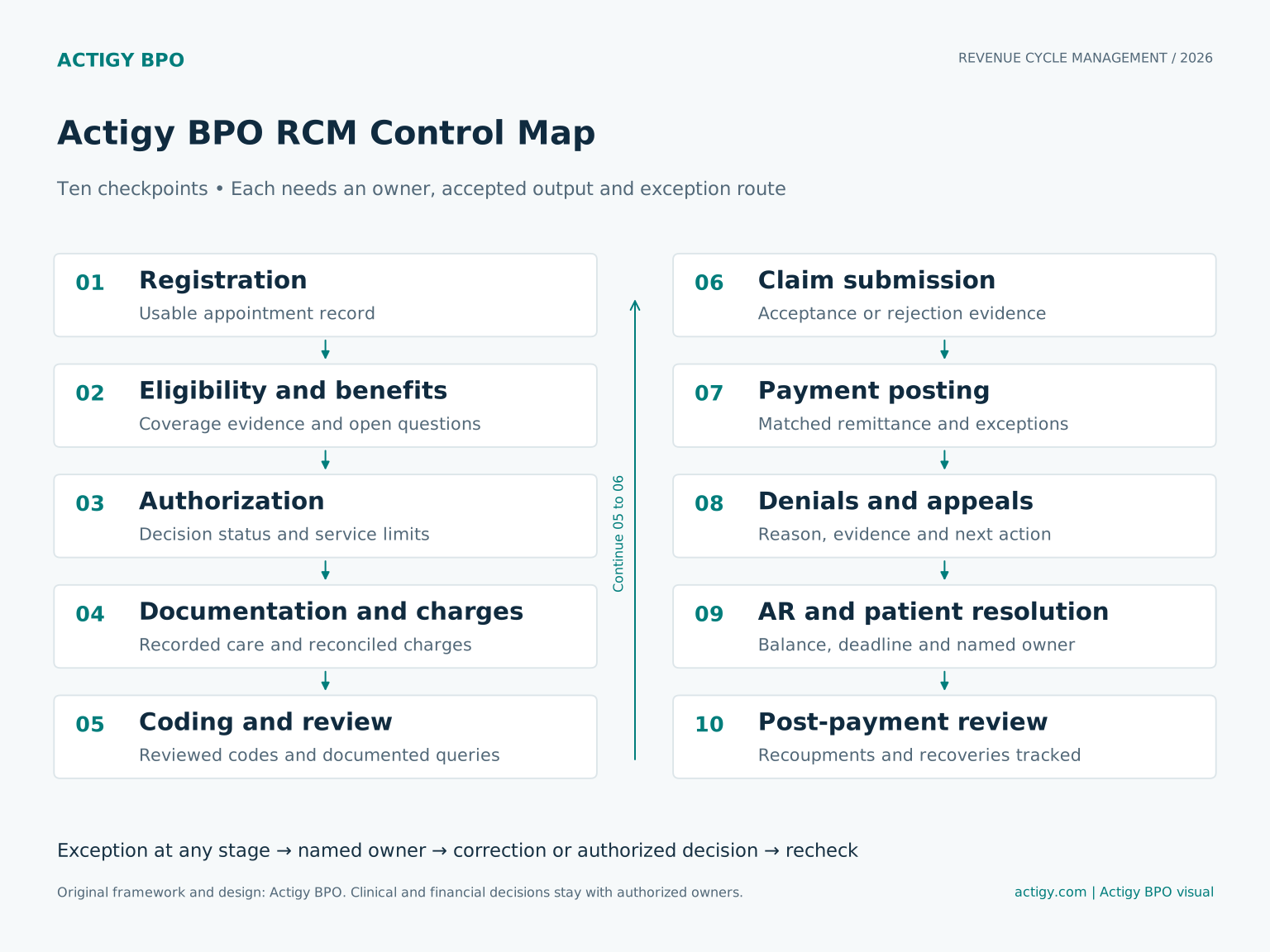
The cycle is commonly organized into front-end, middle and back-end work. The AMA’s physician guide explains those phases and the need for collaboration across clinical and administrative roles. The ten checkpoints below are Actigy BPO’s own working arrangement. They are not a claim that every practice must use exactly ten steps.

Front end before the encounter
1. Registration and scheduling. Collect the information needed to identify the patient, planned service and responsible payer. Resolve conflicting records rather than creating another record that later teams must reconcile. The useful output is a usable appointment record with required fields complete.
2. Eligibility and benefits. Check coverage for the service date and record what the payer reports about benefits, limitations and patient responsibility. Keep the source and check time. Active insurance alone does not establish authorization or guarantee payment. Actigy BPO’s insurance eligibility verification service describes how unresolved questions move to the practice’s named owner.
3. Authorization and patient financial preparation. Where required, track the authorization request, supporting records, decision and expiry or service limits. Separate the payer’s decision from the team’s processing time. Give patients a clear explanation of estimates and available support under the provider’s policy. Administrative staff should escalate clinical questions rather than infer answers.
Middle cycle during and after care
4. Documentation and charge capture. Establish what care was actually delivered and whether required documentation is complete. Compare recorded services with charges through an approved reconciliation process. A missing clinical note goes back to the clinician. It is not a gap for a biller to fill by guessing.
5. Coding and review. Translate the documented encounter into the applicable codes and modifiers through qualified review. Log unresolved questions and the evidence supporting corrections. Actigy BPO’s medical coding outsourcing scope keeps coding policy and unresolved clinical questions with the client.
6. Claim preparation and submission. Run applicable edits, investigate failures and confirm submission acceptance. A clearinghouse acknowledgement is evidence of a transmission stage. It does not mean the payer has approved or paid the claim. Keep rejection correction separate from an appeal of an adjudicated denial.
Back end through resolution and review
7. Remittance and payment posting. Match payments and remittance details to the correct accounts. Flag unmatched items and unexpected adjustments. The completion condition is a reconciled record, not simply an entry in the ledger. Actigy BPO provides payment posting services within agreed permissions and review rules.
8. Denials and appeals. Group the stated reasons, validate the history and choose the appropriate next action. Some cases need a correction. Others need evidence, an appeal or a client decision. Keep filing deadlines visible and feed repeat causes back to the originating team. See Actigy BPO’s denial management services for the operating scope.
9. Receivables and patient account resolution. Prioritize unpaid accounts by age, value, deadline and actionability. Give each account a next action and an owner. Explain patient balances using approved communications, and route assistance, disputes and financial decisions appropriately. Actigy BPO’s AR follow-up services focus on assigned queues and documented outcomes.
10. Post-payment review. Compare expected reimbursement with recorded payments and track recoupments, corrections and appeals after payment. The account may need to reopen. Keep the reason and financial effect visible so that reporting does not count an earlier payment as a permanent result.
RCM versus medical billing and medical coding
Medical billing is part of RCM. Coding supplies structured information about documented care. RCM connects both activities with patient access, authorizations, receivables and financial reconciliation. Buying billing software, hiring a coder and outsourcing a revenue cycle queue solve different problems.
| Function | Main question | Typical output |
|---|---|---|
| Medical coding | Does the coded record accurately represent documented care under applicable rules? | Reviewed codes and documented queries |
| Medical billing | Is the claim or patient bill prepared, transmitted and followed up correctly? | Submitted claims, statements and action records |
| Revenue cycle management | Does the entire encounter-to-payment process resolve correctly? | Connected workflows, reconciled balances and performance reporting |
| RCM software | Can systems support the required data, transactions and controls? | Technology capability requiring configuration and operational ownership |
| Managed RCM services | Who will perform and supervise an agreed part of the work? | Named teams, accepted outputs, QA and escalation records |
If the systems are adequate but work queues lack capacity or ownership, evaluate operating support. If data cannot move reliably between systems, identify the integration or configuration problem before adding people. Actigy BPO’s medical billing outsourcing service is a managed delivery option in an agreed scope, not a replacement EHR.
Which revenue cycle KPIs should you track?
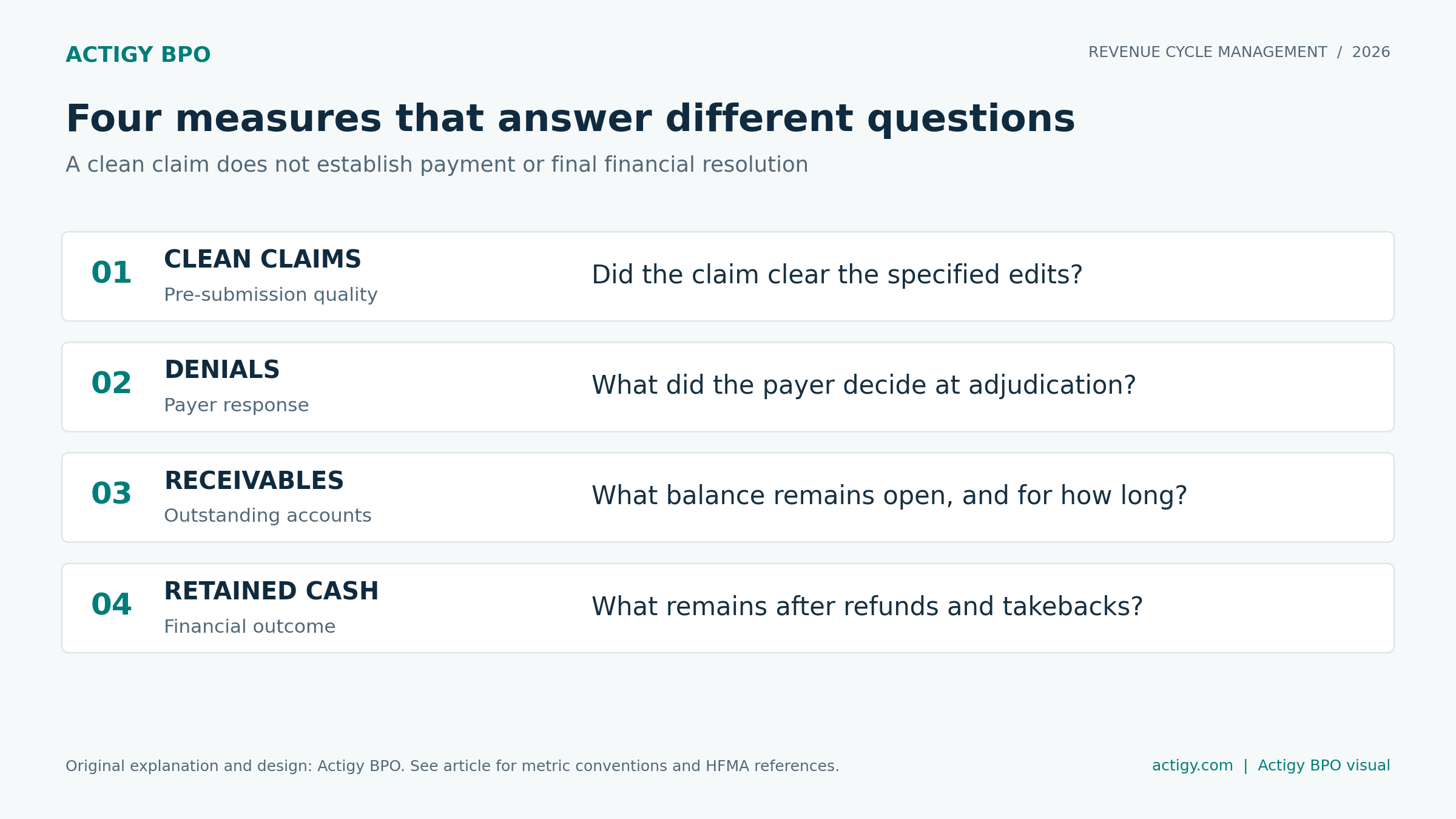
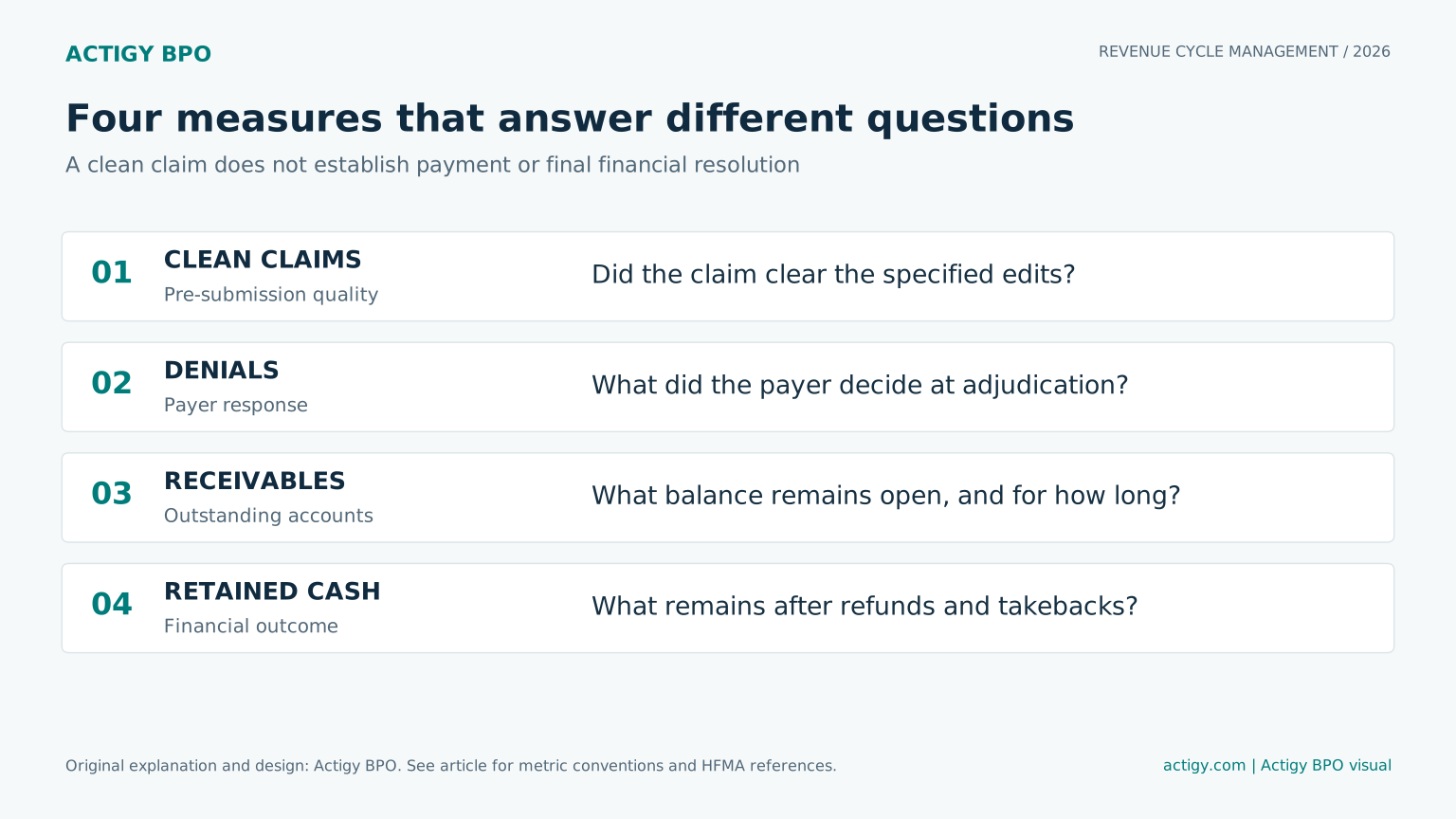
Actigy BPO recommends a compact dashboard that connects claim quality, processing time, outstanding balances and retained cash. Use the same population and reporting window each period. Show a missing or invalid denominator as unavailable, never as a perfect score.
Two established reference points are HFMA’s clean claim rate and net days in accounts receivable. In simplified terms, the first measures claims clearing edits without manual work relative to claims entering the processing tool. The second relates net receivables to average daily net patient service revenue, using the specified recent three-month basis. Apply the full HFMA MAP Key inclusions and exclusions before comparing formally with peers.
The other measures below are practical worksheet conventions. They are not labeled as HFMA benchmarks. A percentage based on claim counts is different from one based on dollars or claim lines.
| Measure | Calculation or record | Interpretation safeguard |
|---|---|---|
| Clean claim rate | Claims clearing edits without manual work ÷ claims entering the processing tool × 100 | A pre-submission quality measure, not payment success |
| Net days in AR | Net patient AR ÷ average daily net patient service revenue | Reconcile net balances and the revenue period first |
| First-adjudication denial rate | Claims denied at first adjudication ÷ claims first adjudicated in the same cohort × 100 | Keep partial denials and claim-line rules explicit |
| Aged AR share | Open AR dollars older than the chosen threshold ÷ all open AR dollars × 100 | Define the age start date and gross or net basis |
| Posting exception rate | Unresolved posting exceptions ÷ payment records reviewed × 100 | Record financial value as well as the count |
| Accepted handoff time | Elapsed time from complete input to accepted downstream output | Report median and 90th percentile, with exclusions visible |
| Cost per resolved account | Allocated operating cost ÷ accounts resolved under the agreed definition | A write-off can close work without collecting cash |
| Post-payment adjustments | Recoupments and recoveries recorded separately, by payer and period | Never hide takebacks inside a net adjustment total |

A worked example of why definitions matter
Consider a hypothetical cohort of 1,000 claims. If 950 pass the specified pre-submission edits without manual work, the simplified clean claim measure is 95%. If all 1,000 later receive their first adjudication and 80 are denied under the agreed count rule, the first-adjudication denial rate is 8%.
Those figures can coexist. They describe different events. They do not imply that 87% were paid, because payment amounts, timing, partial outcomes and subsequent corrections still need reconciliation. Neither percentage measures the money retained after recoupments.
This example is illustrative. It is not an Actigy BPO client result or an industry benchmark.
Use the Actigy BPO RCM operating worksheet
For a weekly team review, the Actigy BPO revenue cycle scorecard (Word) offers a compact six-metric meeting record. Use the broader CSV operating worksheet below when you need queue-level owners and handoff evidence.
Download the free RCM worksheet and the source-linked evidence table. No patient-level data is needed. The worksheet is a blank template for aggregate operating measures, not an automatic benchmark score.
For each queue, record the current baseline, target agreed by the owner, data source, reporting period and completion condition. Attach the source report internally. Then add the next action and the person who can resolve an exception.
The most useful worksheet entry is often a sentence rather than a number. For example: “Eligibility checked, but the authorization requirement is unresolved and assigned to the authorization lead.” That tells the next team what can proceed and what still needs a decision.
Five checks before accepting a handoff
1. Input: Are the required records complete and linked to the right account?
2. Action: Is there evidence of the work performed and its result?
3. Owner: Has the next team accepted responsibility?
4. Exception: Does unresolved work have a reason, deadline and escalation route?
5. Outcome: Does reporting distinguish operational closure from payment and final financial resolution?
Actigy BPO’s worksheet uses these five checks to make stalled work visible. It is an editorial operating aid. It has not been validated as a predictive index, and its fields should be adapted to the provider’s contracts and policies.
Need help with the queue you uncover? Ask Actigy BPO to scope a revenue cycle pilot. Share the process, aggregate volume, payer mix and systems. The next step is a process audit and written scope for a paid pilot. Do not send patient records through the general contact form.
Use Actigy BPO’s billing process checklist to inspect an individual queue. Use the claim denial statistics guide when selecting external denial comparisons.
What AI and automation can improve
Automation is most useful when the input, rule and expected output are sufficiently defined. It can help route work, flag incomplete fields, match records or surface exceptions for review. A workflow still needs an accountable owner when the output is incomplete, inconsistent or clinically consequential.
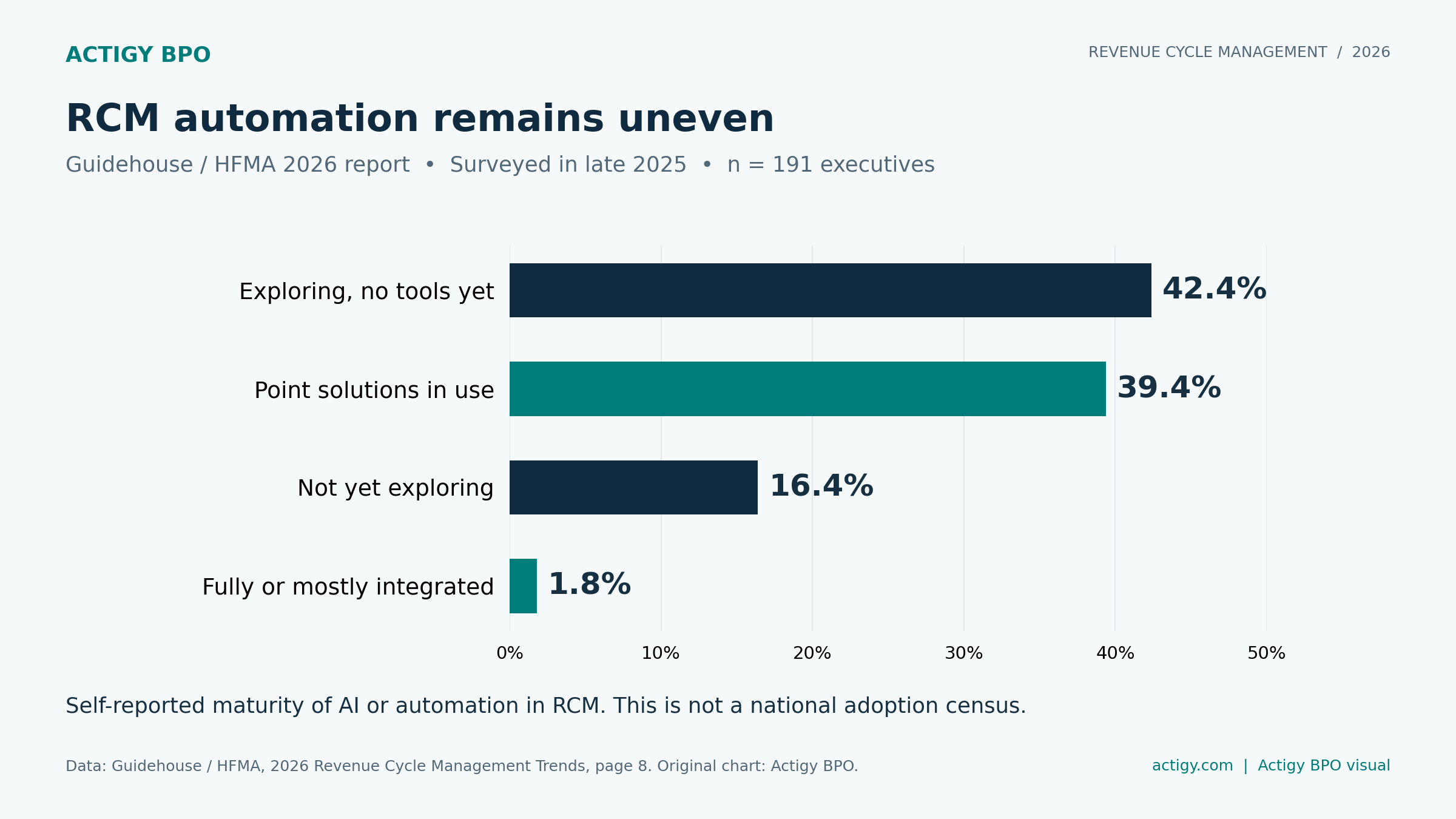
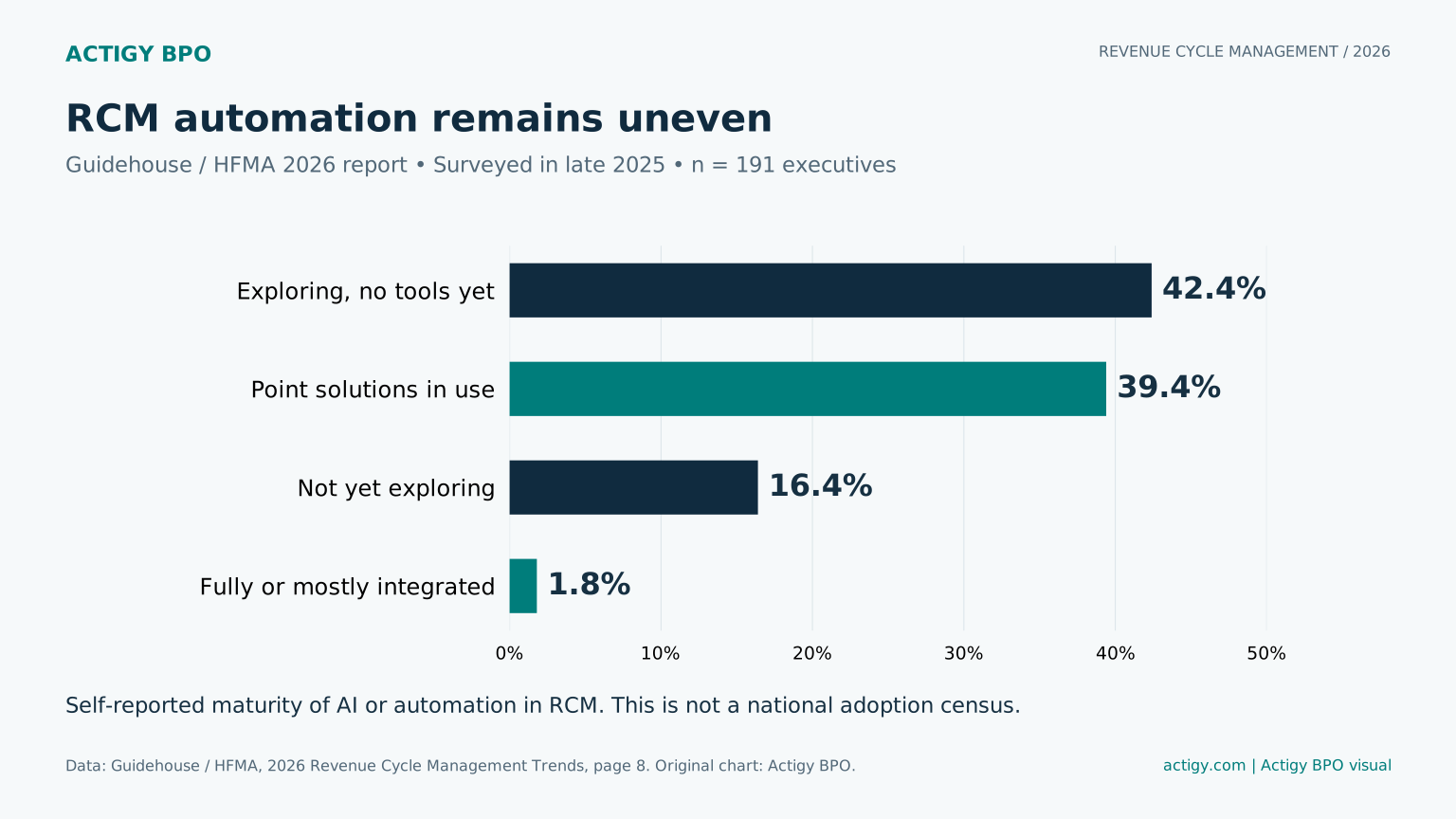
The Guidehouse/HFMA 2026 report shows how uneven deployment remains: 39.4% reported point solutions, while 1.8% reported full or mostly full integration across RCM. The survey was conducted in late 2025. These figures should not be presented as a census of 2026 technology adoption.
| Reported AI or automation maturity | Share of respondents |
|---|---|
| Exploring, with no tools implemented yet | 42.4% |
| Using point solutions | 39.4% |
| Not yet exploring | 16.4% |
| Fully or mostly integrated across RCM | 1.8% |
Test one bounded workflow before expanding automation. Compare error types, accepted outputs, staff review time and total cost against a baseline. Use a separate sample to check whether improved speed comes with more downstream corrections. Keep a fallback route for unavailable systems and questionable outputs.
For clinical documentation questions, medical necessity, coding policy and financial approvals, the relevant authorized professional remains responsible. Do not allow a tool to invent missing evidence or treat its confidence score as payer approval.
For a structured test of automation economics and review effort, use Actigy BPO’s AI Billing Pilot Scorecard. It keeps released capacity, cash savings and collection effects separate.
What the 2026 and 2027 authorization changes mean
Under CMS-0057-F, several operational requirements generally begin in 2026, while the main API requirements generally begin in 2027. For impacted payers other than Qualified Health Plan issuers on federally facilitated exchanges, the decision timeframes are 72 hours for expedited requests and seven calendar days for standard requests. The rule’s authorization provisions concern medical items and services rather than drugs. Exact applicability and dates depend on payer type. See the CMS final rule fact sheet and current CMS process guidance.
For operating teams, maintain a payer-specific requirements register and a record of request status. An API connection does not establish that every request is complete or that every decision will be immediate. Actigy BPO’s prior authorization outsourcing service can support an agreed administrative queue, with clinical judgments retained by the provider.
When managed RCM support is a good fit
Actigy BPO is a relevant option for providers and billing companies with recurring work in existing systems, clear client-owned policies and a need for supervised operating capacity. A focused queue is often easier to evaluate than an undefined promise to improve the entire revenue cycle.
| Situation | Scope to assess with Actigy BPO | What the client should verify |
|---|---|---|
| Multi-provider practice with recurring claim backlog | Billing preparation and defined follow-up queues | Specialty requirements, access and acceptance criteria |
| Multi-site group with inconsistent handoffs | Connected stages with common SOPs and QA | Site variation, retained owners and escalation paths |
| Billing company adding client volume | Managed capacity inside its existing workflow | Client obligations, data permissions and account segregation |
| Provider with aged receivables | A defined AR segment with documented next actions | Recoverability, deadlines and exclusions |
| Team with repeated denial causes | Denial categorization, evidence gathering and correction feedback | Appeal authority and ownership of upstream fixes |
| Organization with unmatched remittances | Payment posting and exception reporting | Reconciliation rules and financial approval boundaries |
A software replacement, a hospital-wide transformation or occasional isolated claims require a different buying decision. Verify whether the actual problem is capacity, process design, technology or payer policy before choosing a delivery model.
For US patient information, evaluate the actual contract and access arrangements. HHS identifies billing and claims processing among activities that can create a business associate relationship. Review the HHS business associate guidance, the applicable agreement, approved locations, subcontractors, access controls and incident process. A delivery region is not evidence of compliance.
A published Actigy BPO example
Actigy BPO reports that its managed team supported eligibility, coding, claims and follow-up for an anonymized telehealth provider. The published RCM case study reports a clean claim rate increase from 84.1% to 97.8%, a gain of 13.7 percentage points, and DSO falling from 48 to 33 days. The client retained clinical, coding and banking authority.
These are Actigy BPO-reported results from one engagement, not independently audited benchmarks. The public case does not establish a causal result for any one workflow or guarantee the same outcome for another provider. Its relevance is the connected operating scope, which can be tested against a buyer’s own baseline.
A 30-day plan to improve your revenue cycle
Start with one bounded problem. Agree what improvement means before changing the workflow. Thirty days can reveal operational progress, but longer follow-up may be needed to observe complete payer cycles and financial outcomes.
| Timing | Owner | Deliverable |
|---|---|---|
| Days 1 to 7 | Revenue cycle lead and finance | Agreed definitions, baseline reports and a map of one problematic queue |
| Days 8 to 14 | Queue owner and retained clinical or policy leads | Required inputs, completion evidence, exceptions and escalation deadlines |
| Days 15 to 21 | Delivery lead and QA | Limited pilot with documented errors, corrections and accepted outputs |
| Days 22 to 30 | Finance sponsor and revenue cycle lead | Review of quality, backlog, cost and emerging payment outcomes, plus continue or revise decision |
Do not expand solely because throughput rises. Check whether the next team accepts the work, repeat defects decrease and open balances are explained. Preserve a consistent comparison cohort, and record changes in payer mix or volume that could affect the result.
Turn a bottleneck into a measurable pilot. Talk to Actigy BPO about revenue cycle management outsourcing or request a scoped pilot. Bring the queue, systems, aggregate workload and desired outcome. Actigy BPO can define the work, retained decisions and acceptance measures before production scope expands.
Related Actigy BPO guides
Evaluate AI with a defined pilot scorecard
Common questions about healthcare RCM
What are the phases of revenue cycle management?
The three broad phases are front-end patient access, middle-cycle documentation and coding, and back-end billing, payment and account resolution. Organizations divide these into different numbers of steps. Actigy BPO’s ten-checkpoint map is one operating framework, with a named owner and evidence at each handoff.
Why is RCM important in healthcare?
RCM helps providers bill accurately, resolve payment problems, understand outstanding balances and explain financial responsibilities to patients. Its value depends on correct work and measurable outcomes, not simply the number of claims or tasks processed.
How can a healthcare organization improve RCM?
Define comparable metrics, identify the queue causing repeat work, clarify its inputs and owner, and test a bounded change. Follow both operational and financial outcomes. Actigy BPO’s free worksheet provides fields for the baseline, source, owner, target and next action.
What is the difference between a rejection and a denial?
A rejection generally means a claim failed an intake or validation step before adjudication. A denial reflects an adverse payer adjudication outcome. The response may therefore require different work. Use the payer’s message and process rules to decide between correction, resubmission, appeal or escalation.
Does a high clean claim rate mean claims will be paid?
No. It shows performance against the chosen claim-edit definition. Payment also depends on coverage, documentation, contract terms and payer adjudication. Track denials, outstanding balances and post-payment adjustments separately.
Can RCM be outsourced without replacing the EHR?
Yes, where permissions, contracts and workflows permit it. Actigy BPO can operate agreed administrative queues in a client’s existing systems. The written scope should define responsibilities, approved access, QA, exceptions and the decisions the client retains.
What is a good revenue cycle KPI target?
There is no single defensible target for every setting. Start with a consistent internal baseline, then compare with peers using the same definitions, period, payer mix and care setting. Use HFMA’s full metric specifications where applicable. A published percentage without a denominator is not a usable benchmark.
Download the Actigy BPO working files
Download the editable RCM operating worksheet CSV
Download the evidence table CSV
Methodology and source notes
This is an editorial synthesis, checked on October 18 2026. It is not a new survey or a meta-analysis. We prioritized original publisher research, professional associations and government guidance. The evidence table names the underlying year because a report released in 2026 may describe 2024 or 2025 activity.
CAQH estimates transaction costs. MGMA reports a voluntary poll. AMA, Experian and Guidehouse/HFMA report survey responses. Kodiak analyzes its platform data. Their populations, questions and denominators differ. We have not pooled their results or estimated a national average from them.
The workflow, worksheet and explanatory diagrams are Actigy BPO editorial resources. The graphics identify the original research owner where they visualize third-party figures. The Actigy BPO case study is labeled separately as company-reported evidence. No cited organization is represented as endorsing Actigy BPO.
For reuse, credit “Actigy BPO, Healthcare Revenue Cycle Management Guide 2026” and name the original data source shown on the visual. Link to this guide and the research source so readers can check the methodology. Contact Actigy BPO for corrections or reuse questions.
Research and guidance
- CAQH 2025 Index release , February 19 2026. Core transaction findings use 2024 data.
- MGMA revenue cycle leakage poll , published January 7 2026. Poll fielded January 6, with 288 applicable responses.
- AMA 2025 Prior Authorization Physician Survey , released May 2026. National survey of 1,000 physicians.
- Experian State of Claims 2025 release , September 22 2025. Survey of 250 healthcare professionals.
- Experian healthcare industry research , accessed October 18 2026. Separate January-February 2026 survey of 200 leaders.
- Guidehouse and HFMA 2026 Revenue Cycle Management Trends . Survey of 191 provider executives in late 2025.
- Kodiak Solutions release , September 15 2026. First-half 2025 and first-half 2026 platform comparison.
- HFMA revenue cycle overview and MAP Keys , accessed October 18 2026.
- AMA physician guide to effective RCM , updated August 2025.
- CMS final rule fact sheet and implementation FAQs , accessed October 18 2026.
- HHS business associate guidance , accessed October 18 2026.
- Actigy BPO telehealth RCM case study , updated October 4 2026. Company-reported evidence.