AML & KYC Outsourcing RFP Template: Backlog, QA & Vendor Scorecard
Actigy BPO’s free AML and KYC outsourcing RFP includes an editable Word template and an Excel vendor scorecard. Use them to compare managed analyst teams on eligible casework, client approvals, backlog capacity, independent QA, surge cover and paid-pilot acceptance.
Free downloads. No email required.
What should an AML outsourcing RFP include?
The Actigy BPO AML and KYC outsourcing RFP starts with four workload inputs. Share the opening backlog by age and severity, weekly arrivals, case mix and observed handling time. Give all bidders the same redacted case, approved actions and decision owners. Ask for an acceptance definition for each output before comparing staffing estimates.
| RFP section | What bidders should provide |
|---|---|
| Queue and casework | Eligible alerts and KYC files, allowed steps, sample rationale and the completed output for each risk tier. |
| People and coverage | Analyst, lead and independent QA cover by shift, relevant credentials, productive hours and named backup. |
| Quality and handoff | A case sample with evidence references and timestamps, QA notes, an escalation owner and a backup route. |
| Systems and access | Named permissions, approved tools and access locations, logging, and proof that access can be revoked. |
| Commercials and reserve | Ramp and readiness charges, pricing by role, buyer review costs, reserve retainer, activation fees and the maximum surge. |
Separate identity onboarding, periodic refresh, remediation and enhanced due diligence by file type. Set a throughput target for each queue. Use the KYC file checklist to define a complete submission, the AML audit checklist to check operating controls, and the merchant KYB capacity planner to size merchant reviews.
For staffing and delivery, see AML outsourcing for alert review and KYC outsourcing for case preparation.
Which decisions stay with the client?
Actigy BPO teams prepare evidence and record or escalate outcomes within the buyer’s written permissions. The client compliance owner approves policies and thresholds, defines eligible casework, decides customer or merchant risk, and owns suspicious activity report (SAR) or suspicious transaction report (STR) decisions and filing. Name a deputy for each escalation and agree who takes over if an approver misses the clock.
Verify which rules apply to the buyer’s entity and workflow before issuing a bid. The 2023 U.S. interagency guidance covers risk management across third-party relationships for supervised banking organizations. Article 18 of EU Regulation 2024/1624 sets outsourcing conditions. The regulation generally applies from 10 July 2027 under Article 90. The EBA’s September 2026 final guidelines for non-ICT third-party risk have their own application and transition provisions. Determine which framework and dates govern the institution before contracting.
For institutions in its scope, the DNB Wwft Q&As, page 42, state that ongoing monitoring cannot be outsourced to a third party and explain a specific intra-group case. Confirm task eligibility before assuming an alert or periodic review queue can be assigned to an outside team.
How many analysts do you need for a backlog of 1,200 alerts?
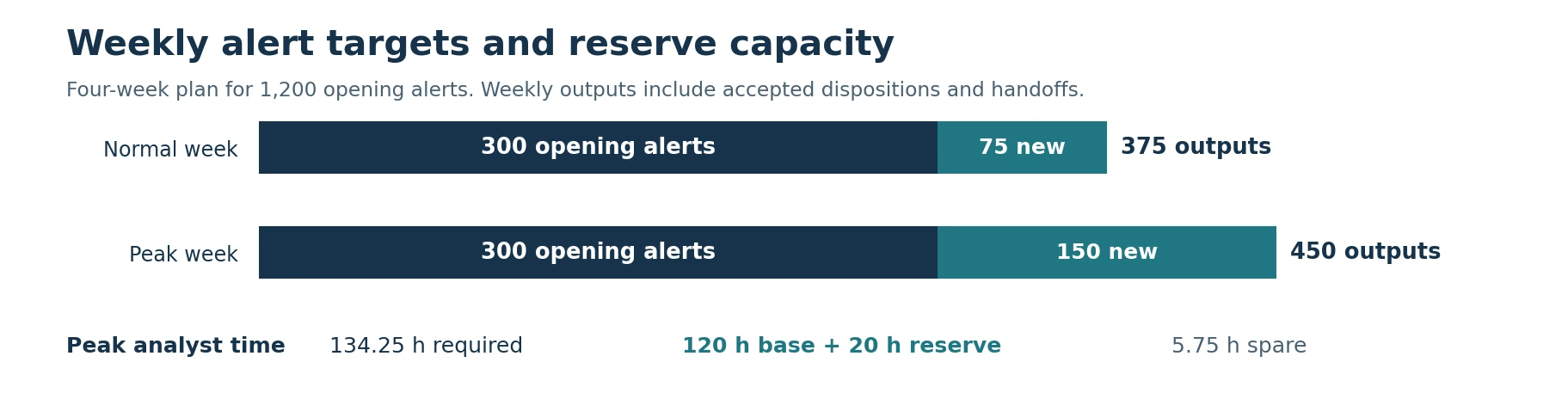
In Actigy BPO’s illustrative sizing model, four analysts at 30 productive hours each can cover 375 accepted outputs in a normal week. The team clears 300 opening alerts and handles 75 arrivals each week, for 1,500 expected outputs over four live weeks. If arrivals rise to 150 in one week, the target becomes 450 outputs and 134.25 analyst hours. A trained 20-hour reserve provides 140 productive hours that week.
| Assumption or result | Normal week | Peak week |
|---|---|---|
| Opening backlog target plus arrivals | 300 + 75 = 375 | 300 + 150 = 450 |
| Analyst demand / available | 111.875 / 120 hours | 134.25 / 140 hours |
| Independent operational QA | 105 reviews / 14 hours | 126 reviews / 16.8 hours |
| Lead review and governance | 11 hours | 12.2 hours |
Weight the processing time by case mix. The example uses 70% standard alerts at 12 minutes, 20% intermediate at 25 minutes and 10% complex at 45 minutes. The weighted mean is 17.9 minutes. The workbook estimates 1,575 total outputs with one peak week, assuming arrivals in the other three weeks remain at 75. Define the clock after readiness and confirm whether the sample handling time includes correction work.
In its 2024 TD Bank consent order, FinCEN recorded more than 70,000 backlogged detection alerts in the bank’s AML program in 2018, with less than 60% within its timely-detection benchmarks. The remediation record identified inadequate staffing and monitoring-system issues. Ask each bidder to report capacity shortfalls and cases blocked by the system separately.
How many QA reviews should an AML vendor plan?
Actigy BPO’s model assumes 20% of outputs require mandatory review and samples 10% of the rest. In a 375-output week, the independent reviewer checks all 75 flagged items and 30 of the remaining 300. At eight minutes per review, 105 reviews require 14 hours. At 450 outputs, the same rules yield 126 reviews and 16.8 hours.
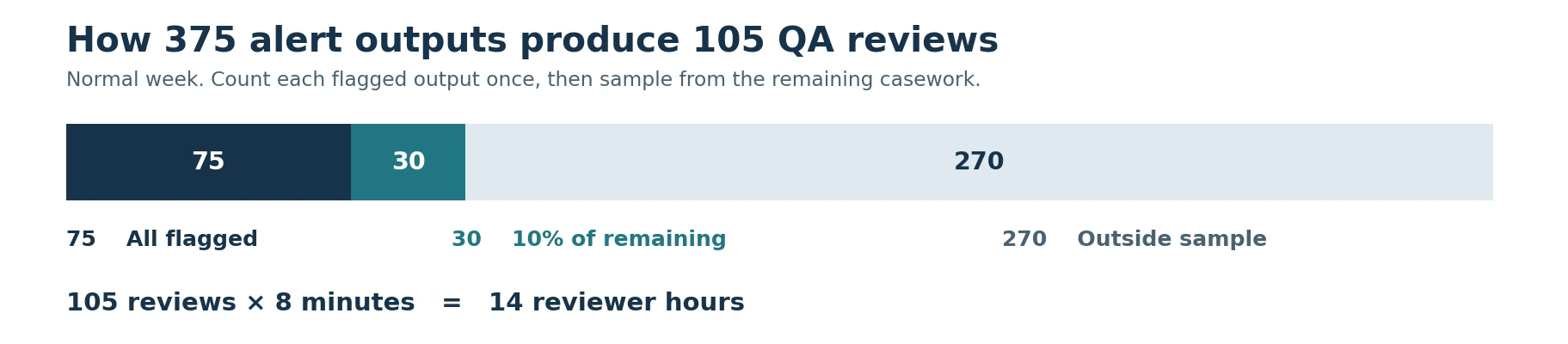
The example allocates 0.6 QA FTE with 18 productive hours and 0.5 lead FTE with 15. Peak headroom is 1.2 hours for QA and 2.8 for the lead. Check reviewer and lead cover as separate decisions before activating extra analyst hours. Confirm the flagged population with compliance and count overlapping high-risk and escalation flags once.
Report accepted dispositions and accepted escalation handoffs by unique item ID. Separately record reopens, cases waiting on the client, and actual filings. The FinCEN FY 2025 Year in Review recorded about 4.8 million SARs in its U.S. filing data. A staffing model uses the buyer’s own eligible alert arrivals and case mix. Ask for traceable notes and an aging report. The FCA’s challenger-bank review documented examples of late reviews and incomplete investigation records.
How should you compare AML and KYC outsourcing bids?
Actigy BPO’s Excel scorecard checks seven mandatory requirements first. Mark each Pass, Pending or Fail and attach a reviewable evidence reference. Resolve pending items before ranking bids. Set the eligibility rules and the tie-break before reading proposals.
- Approve the eligible tasks, retained decisions, escalation owner and deputies.
- Demonstrate named access, MFA, role limits, logging and offboarding.
- Agree on data and staffing locations, subprocessors, retention and incident terms.
- Retrieve time-stamped work records, supporting evidence and decisions.
- Demonstrate independent operational QA and the critical-defect response.
- Verify continuity, secure handback and post-exit access removal.
- Validate qualifications, staffing availability and coverage before live work.
| Criterion | Weight | Evidence to compare |
|---|---|---|
| File quality and QA | 25% | Case file, review history, sampling and defect response. |
| Escalation and oversight | 20% | Clock, role owner, authorized route and backup. |
| Access and audit evidence | 15% | Roles, locations, logs and evidence references. |
| Backlog and surge capacity | 12% | Aging plan, observed handling time and reserve proof. |
| Staffing and training | 8% | Named analyst, lead and separate QA cover. |
| Pricing and assumptions | 8% | Role quotes, ramp, retained work and flex terms. |
| Pilot and transition | 7% | Readiness checks, runbook and case handback. |
| Comparable references | 5% | Verified example from a similarly scoped queue. |
Score eligible bids from 1 to 5 per criterion. Multiply the maximum points available by the rating divided by five. Sum to a total out of 100. Ask every bidder to price the same authorized live window, volume and mix, plus ramp, lead, independent QA, tooling and retained buyer work. Price standby and activation separately. Specify when the reserve can start, how many trained hours it adds and what happens beyond the cap. See the general outsourcing RFP and cost scorecard for a longer cost comparison.
What should the redacted exercise and paid pilot prove?
Give each bidder the same fictionalized alert, relevant policy excerpt and test access. Require the evidence IDs, actions taken, rationale and timestamps for either a permitted disposition or escalation. Include one deliberately incomplete record. Check that the analyst identifies the missing evidence, uses the right escalation route and leaves the decision with the named owner. Ask the independent reviewer to record defects and the correction owner.
In a separate Actigy BPO illustrative pilot, 100 unique outputs are accepted. The QA sample covers 28, of which 27 pass on the first review (96.4%). The sample observes zero critical defects and 12 of 12 eligible handoffs meet the agreed staffed clock. Review the missed check and unresolved client decisions before sign-off. Pause for critical defects according to the agreed protocol. Give the buyer compliance owner the release decision and record conditions that need a retest.
In a published digital asset exchange alert-triage case, Actigy BPO reported a change from 26 to 3 minutes per triage over five months, with a reported scope of 11,200 alerts a month. Use the workflow and the exchange’s retained decisions as reference points. Size a new pilot with its own case mix, access and approval rules.
Scope your workflow
Share aggregate starting volume, weekly arrivals, case mix, deadline, working hours and permitted access locations. Actigy BPO can review the analyst, lead and QA allocation and outline what a pilot should prove. Keep customer records in your approved systems.