Medical Billing RFP Template and Vendor Scorecard
Actigy BPO’s medical billing RFP template gives U.S. practices and healthcare organizations an editable Word brief and Excel scorecard. Use them to assign claims, payment posting, denial follow-up and accounts receivable by queue, check mandatory controls and compare 12 months of vendor and buyer costs.
Free downloads. No email required.
What should a medical billing RFP include?
The Actigy BPO medical billing RFP starts with aggregate monthly initial claims, payer and specialty mix, remit lines, outstanding accounts receivable (A/R) by age, and the practice’s electronic health record (EHR), billing and clearinghouse systems. Give each bidder the same cutoff, out-of-scope work, approval matrix and redacted cases. Price new claims and inherited A/R separately.
| Quote line | Evidence and owner |
|---|---|
| New claims and rejections | Show the original submission and first acknowledgment, describe the authorized correction path, and assign responsibility for late or blocked claims. The practice approves coding policy and clinical documentation. |
| Payment posting | Reconcile remit lines to postings, report unmatched or unapplied amounts, and log exceptions. The practice controls banking changes and reconciles deposits. |
| Denials and A/R | Separate new denials and legacy A/R by age and payer. Show the deadlines, appeal steps, history and next owner. The practice approves write-offs and refund policy. |
| Optional work | Price coding, eligibility, credentialing and patient calls separately. Name who can contact a patient and when the practice takes over. |
Compare how public buyers separate work. Los Angeles County’s HS-1162 solicitation requested billing, collections and follow-up. Bangor’s P26-62 procurement asked about clearinghouse partners, posting, denial handling and costs within its broader EHR and billing scope. Specify which components your bidder will run in your system and where a different owner is needed.
Use the medical billing process guide for the steps from patient intake through payment posting. For procurement across departments, start with the general outsourcing RFP.
How should you measure initial payer denials?
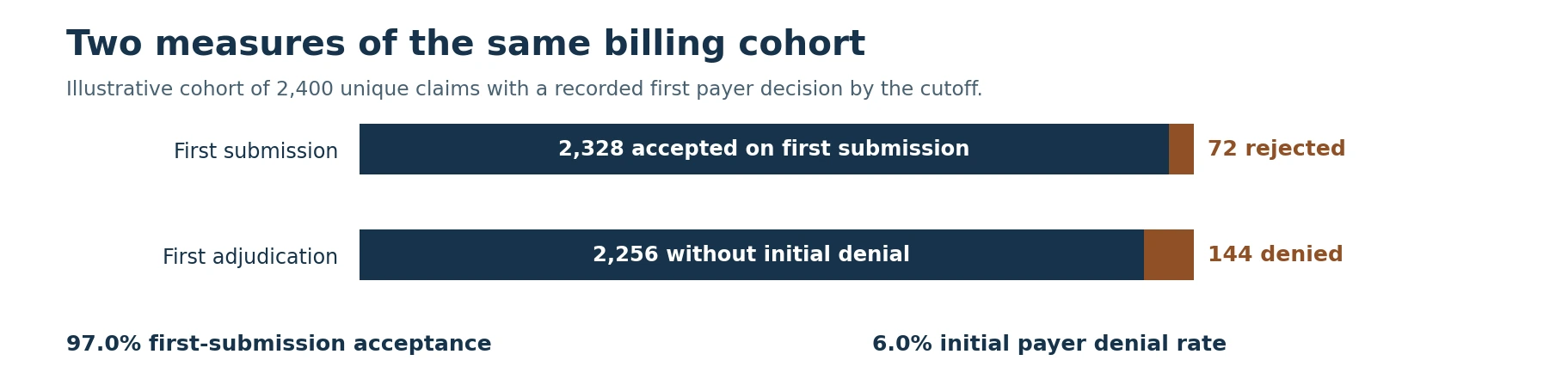
Divide original claims denied at first payer adjudication by original claims with a first adjudication by the cutoff. Report claims still awaiting a payer decision separately. In Actigy BPO’s illustrative cohort, 144 of 2,400 adjudicated claims were initially denied, a 6.0% initial denial rate. At the earlier clearinghouse stage, 2,328 of the same 2,400 claims passed first submission, or 97.0%, and 72 were rejected.
| Measure | What your bidder should show |
|---|---|
| First submission acceptance | First acknowledgment per original claim, plus the payer and specialty mix and how corrections are tracked. Here 2,328 passed and 72 were rejected. |
| Initial payer denials | First adjudication per original claim, reasons, cutoff, unresolved count and next action. Here all 2,400 had decisions after corrections, with 144 initially denied. |
| Posting QA | Remit lines posted correctly, sample size, amount corrections and approvals. |
| A/R follow-up | Starting and ending aged balances, next-action owner and separate values for receipts, adjustments and write-offs. |
The CMS electronic billing transaction guide identifies the 277CA as a claim acknowledgment and the 835 as payment or remittance advice. Ask bidders to match both to the original claim and practice ledger and document missing records. Agree metric definitions with the RCM KPI dictionary before the trial.
In KFF’s analysis of CMS data, about 85 million of 451 million reported in-network claims from the included HealthCare.gov insurers were ultimately denied in 2024, about 19%. The study excludes initial denials later resubmitted and paid from its denial rate. Use your own payer mix and first adjudications for pilot targets.
What does a medical billing vendor have to prove?
Actigy BPO’s scorecard checks the following seven requirements before ranking vendors. Ask the practice’s privacy, billing and finance owners to record an evidence reference and decision for each.
- Approve any required business associate agreement (BAA) and the protected health information (PHI) scope, processing locations and subcontractors.
- Verify named access, role limits and separation of financial approvals.
- Test the original-claim-to-remit handoff in the agreed systems.
- Confirm filing and appeal ownership, including the legacy A/R cutoff.
- Validate staffing, backup cover and continuity through a test.
- Approve patient contact rules and exception routes.
- Demonstrate record export, open-work handback and access removal.
For arrangements involving a business associate, the HHS sample contract provisions describe PHI uses, safeguards, reporting, obligations that flow down to applicable subcontractors, and return or destruction where feasible. Confirm the agreement and allowed access before any live pilot.
CMS National CERT estimated $33.96 billion in improper Medicare fee-for-service (FFS) payments in reporting year 2026, 7.32% of $464.11 billion in expenditures. The window covers claims submitted July 2024 through June 2025. Insufficient documentation accounted for 54.2% in Table A3’s adjusted breakdown of estimated improper payment dollars. Ask each bidder to show how a documentation gap gets to the practice and how the final action is verified.
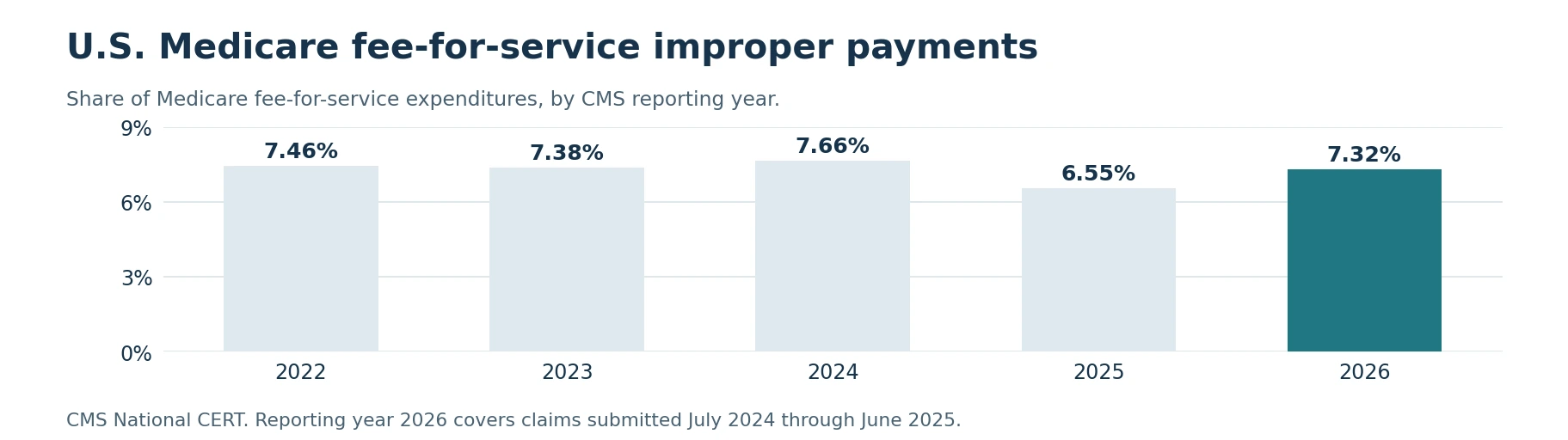
The National CERT rate was 7.46% in 2022, 7.38% in 2023, 7.66% in 2024, 6.55% in 2025 and 7.32% in 2026. These are national estimates for the share of expenditures. The pilot uses practice-specific submission and denial measures.
How should you weight an eligible billing vendor’s score?
| Criterion | Weight | Evidence to score |
|---|---|---|
| Denial and A/R execution | 20% | Aged queues, filing owner and worked denial. |
| Data protection and approvals | 20% | Applicable BAA, named access and approval limits. |
| Claim and remit reconciliation | 15% | Original claim, acknowledgment, decision, remit and posting. |
| QA and reporting | 15% | Sampling, defect definitions and posting corrections. |
| Transition and continuity | 10% | Named backup, response to interruption and cutover plan. |
| Normalized cost | 10% | Shared scope, itemized charges and collection basis. |
| Staffing and references | 5% | Relevant specialties, payers and systems. |
| Commercial and exit terms | 5% | Tail fees, records export, handback and access removal. |
Score eligible bidders from 1 to 5 per criterion. Each contributes its maximum points multiplied by the rating divided by five. Set thresholds and tie handling before bids are opened.
How do you compare fixed fees and percentage of collections?
Actigy BPO’s 12-month example compares a $92,000 fixed bid with 4.5% of eligible net collections plus $23,600 in tools, retained oversight and setup. At $1.5 million collected, the percentage bid costs $91,100. Both cost $92,000 at the $1.52 million crossover. For live bids, use the same scope, collection basis, claim volume and cutoff.
| Eligible net collections | Fixed bid | 4.5% bid | Difference for percentage bid |
|---|---|---|---|
| $1.2 million | $92,000 | $77,600 | $14,400 lower |
| $1.5 million | $92,000 | $91,100 | $900 lower |
| $1.8 million | $92,000 | $104,600 | $12,600 higher |
The fixed bid has a $6,000 monthly retainer, $1,250 a month in tools and retained review, and $5,000 in setup. The percentage bid has $1,300 a month in tools and review, $8,000 in setup and no monthly retainer in this example. Define refunds, reversals, legacy collections and the timing of eligible receipts. Price the clearinghouse, internal review and inherited A/R separately where applicable. If a quote has floors, per-claim fees or tiers, request the comparison month by month.
What should the pilot and parallel run prove?
Use a common exercise. Ask bidders to demonstrate a clean submission, a clearinghouse rejection, a first payer denial and a remit posting. Require the timestamp, approval boundary, next-action owner and audit trail for all four. Check that each original claim has one submission owner during a parallel run.
| Step | Evidence | Release decision |
|---|---|---|
| Redacted exercise | Agree the payers and workflows and score comparable outputs from the same sample. | Shortlist after mandatory evidence and thresholds are met. |
| Authorized limited live pilot | Reconcile sampled remit lines to posting, record timely follow-up, and log exceptions and patient-impacting issues. | Expand after practice sign-off on results and open items. |
| Cutover and handback | Backlog by age, agreed owners and deadlines, claim and remit exports, access removal plan. | Release the next cohort after checking for duplicate submissions and verifying handback records. |
Agree a cutoff by site or cohort. Give old A/R a separate owner and reconcile the last outbound submission and first inbound remit when responsibility changes. Keep the practice’s clinical, coding and banking approvals in place.
In an anonymized telehealth revenue-cycle engagement, Actigy BPO reported that the clean claim rate went from 84.1% to 97.8% and days sales outstanding fell from 48 to 33 days. The report covers several revenue-cycle stages. Request each bidder’s measured cohort and cutoff before applying any comparison to your own pilot.
Explore medical billing outsourcing for delivery scope and the revenue cycle management guide for the full workflow.
Scope your workflow
Share approximate claim volume, specialties, payer mix, EHR or practice management system and the queue that needs support. Actigy BPO can review the scope and propose a staffing estimate and pilot. Share aggregate figures and leave patient and claim records in your approved system.